
Denver proposal would split mobility fund between capital projects and operations
The committee-stage measure would reserve half the fund for capital work, bar general-fund transfers and potentially shift some current parking and transportation costs to citywide accounts.
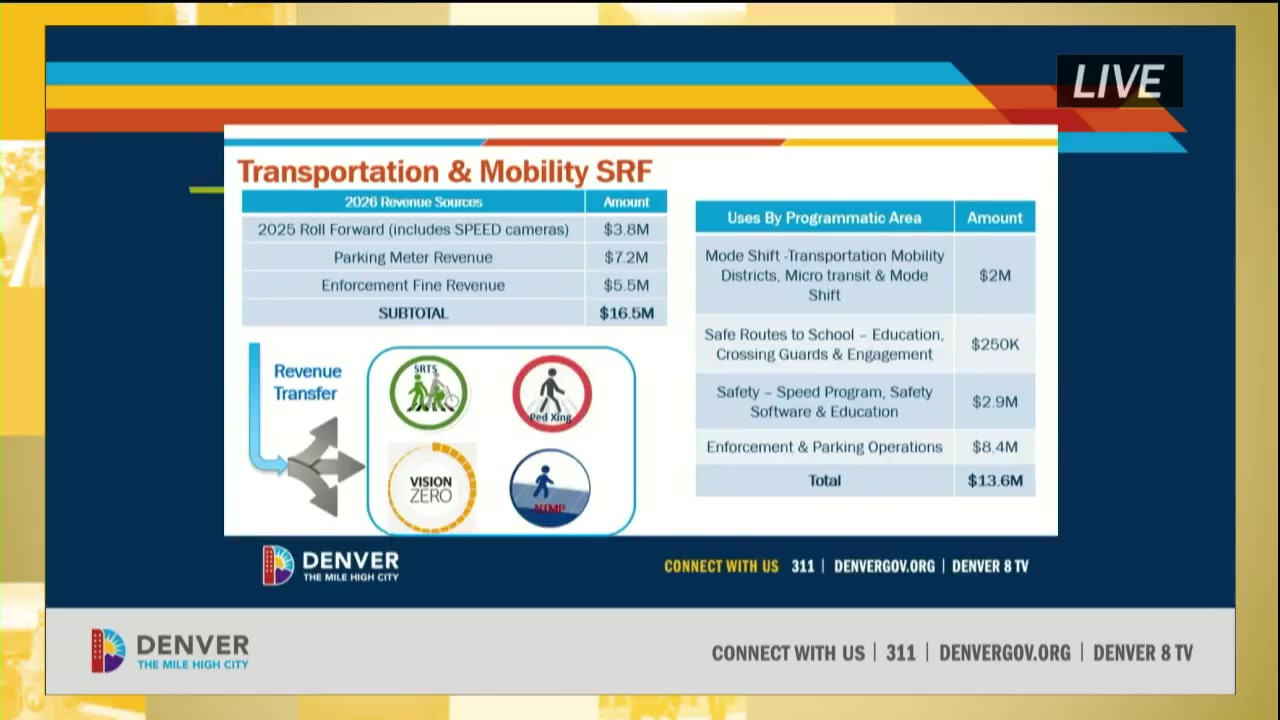
A Denver City Council proposal would reserve half of the city’s Transportation and Mobility Special Revenue Fund for capital projects and limit the other half to operations. It also would bar transfers to the general fund and require unused money to roll over.
The proposal was briefed July 27 to the council’s Budget and Policy Committee. It has not been adopted, and the available record does not show that legislation had been formally introduced after the briefing. The committee adjourned without taking action, the meeting record shows.
What the proposal would change
The fund was created in 2021 after the city raised parking-meter rates to support pedestrian, bicycle and transit improvements, Safe Routes to School and Vision Zero safety work. Sponsors said it collected about $16.5 million in 2026. They said about $8.4 million was going to enforcement and parking operations, leaving $8.1 million for other mobility and safety work.
The proposed 50/50 rule would keep either capital construction or ongoing operations from consuming the fund. Capital uses described in the briefing included protected bike lanes, bus and accessibility lanes, traffic-calming features, bike and scooter corrals, bus-stop infrastructure, transit-speed improvements and road diets. Sponsors said RRFB and HAWK signals could qualify when paired with self-enforcing traffic-calming work, but the draft otherwise would bar the fund from purchasing, installing, reconstructing or retiming traffic signals and similar equipment.
The draft also would tie spending to adopted plans, including the Vision Zero Action Plan, Safe Routes to School Action Plan and Denver Moves plans. It would exclude general-fund transfers, traffic modeling, police-base enforcement, unrelated signage, routine street maintenance, stand-alone studies or engineering, marketing and education campaigns, and removal of existing pedestrian, bicycle or transit safety infrastructure. Balances would carry over from year to year.
Those limits could change who pays for existing programs. Andy Ford, executive director of the Denver Department of Transportation and Infrastructure, said current fund uses include microtransit connectors serving Westside/Globeville-Elyria-Swansea and Montbello, transportation-management associations, parking-citation review staff, transit-signal and maintenance staff, speed cameras and parking software. He said roughly $2 million is allocated to speed cameras and that parking software and other parking-revenue costs would move to the general fund under the proposal.
Ford said parking-citation review staff supported by the fund were expected to start Aug. 24. That is a planned start date, not evidence that hiring or service had occurred as of the briefing.
Legal and budget questions remain
Council members questioned whether the Dottie Advisory Board could approve the department’s annual spending plan when its role is generally advisory. They also raised concerns about naming specific plans in an ordinance if those plans expire or are replaced. Ford said the agency was still breaking spending out by asset class and program to show how money currently flows.
Sponsors said they were still working with the city’s Budget and Management Office and the administration. The next step would be completion and filing of draft legislation, followed by the council’s committee and ordinance process. The July 27 materials establish a briefing, not a vote or enacted law.
Timing could affect the 2027 budget. Denver City Council says the mayor must submit the proposed 2027 budget by Sept. 15. The city’s budget calendar calls for a public hearing by the fourth Monday in October, council amendments at its first regular November meeting and final appropriations by the fourth Monday in November.
An ordinance adopted before the mayor’s submission could be reflected in the proposed 2027 spending plan. If drafting or legal questions delay it beyond the fall appropriation process, its practical effect would more likely begin with a later budget amendment or the 2028 cycle. No final 2027 allocation change has occurred.