
Arapahoe County draft could more than double land-dedication costs for some subdivisions
A proposed rewrite would use market appraisals and new suitability and waiver standards for parks and schools; a county example shows an $8,060-per-unit increase in cash-in-lieu obligations.
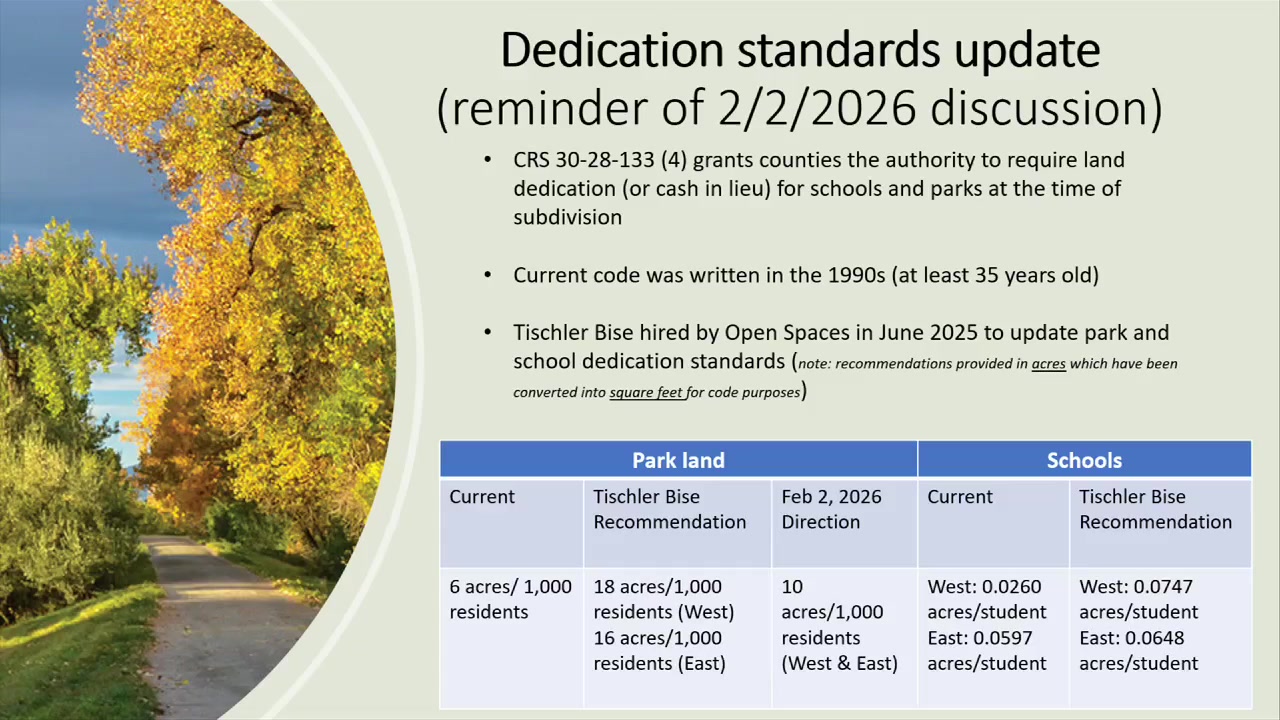
Arapahoe County’s proposed rewrite of its land-dedication rules could more than double parks-and-schools obligations for some new residential subdivisions, while commissioners continue debating whether commercial and industrial projects should also be covered.
The draft, discussed Aug. 10 during a Board of County Commissioners study session, would replace the county’s assumed land-value option with market appraisals, set standards for determining whether offered land is suitable, and allow limited waivers from the standard dedication amount. The official matter record identifies the item as a study-session presentation, not a final action.
A county standards report illustrates the potential effect with a hypothetical 100-unit, west-area single-family subdivision. Under existing standards, the example would require 3.87 acres for parks, schools and other facilities — or $773,000 in cash-in-lieu based on an illustrative land value of $200,000 per acre. Under the proposed standards, it would require 7.90 acres and $1.579 million, an increase of $806,000, or $8,060 per unit. The county’s standards report says the $200,000 figure is illustrative, not a new fee schedule or code valuation table.
The proposed amounts would vary by housing type and service area. In the West Service Area, the draft lists 1,180 square feet of park dedication and 2,206 square feet of school dedication per detached single-household unit. The corresponding amounts are 884 and 1,253 square feet for attached units, and 758 and 937 square feet for multifamily units, according to the draft code revisions.
Staff told commissioners the rewrite would retain parks and schools but eliminate a separate “public purposes” category that included uses such as fire districts and libraries. Dedication to another entity, such as a metropolitan district, would remain allowed. Dedication would still occur at the final-plat stage; cash-in-lieu would be due within 30 days of plat approval, and ground disturbance would be barred until payment, staff said during the board’s recorded discussion.
Developers generally could choose between dedicating land and paying cash, but the county could reject land that failed suitability standards or did not fit planned streets, facilities and other development. Applicants seeking a departure from the standard amount would have to submit a written request and evidence. The previous credit of up to 35% for private parks would be removed, although developers could still build them.
The rewrite is intended to account for additional demand created when residential property is rezoned for greater density. County-initiated rezonings would be exempt, staff said. Commissioners and staff were still considering whether later amendments to an approved development plan or planned unit development — such as smaller lots, more homes or denser housing — should trigger an additional obligation. Commissioners also questioned whether the rules could conflict with efforts to encourage density near transit.
Whether commercial and industrial projects would be covered remained unresolved. Staff said the county lacked enough data to determine the amount of land or cash those uses would require and questioned whether such a dedication could be shown to be reasonably necessary. Commissioners expressed interest in continuing the commercial discussion, particularly regarding trails, parks and multimodal connections, while treating industrial development as potentially different.
Staff proposed circulating the residential-focused draft for three weeks in August and September, followed by Planning Commission and BOCC study sessions and possible final approval in November or December. The proposed effective date is Jan. 1, 2027. The county materials do not identify a comment deadline, submission method or follow-up meeting date, and the accessible official record shows no formal vote authorizing the public-feedback release.