
Arapahoe County forecasts $5 million property-tax decline as reserves face pressure
The preliminary 2027 forecast doubles the county’s expected property-tax decline and projects growing costs will strain several funds before a larger revenue increase in 2030.
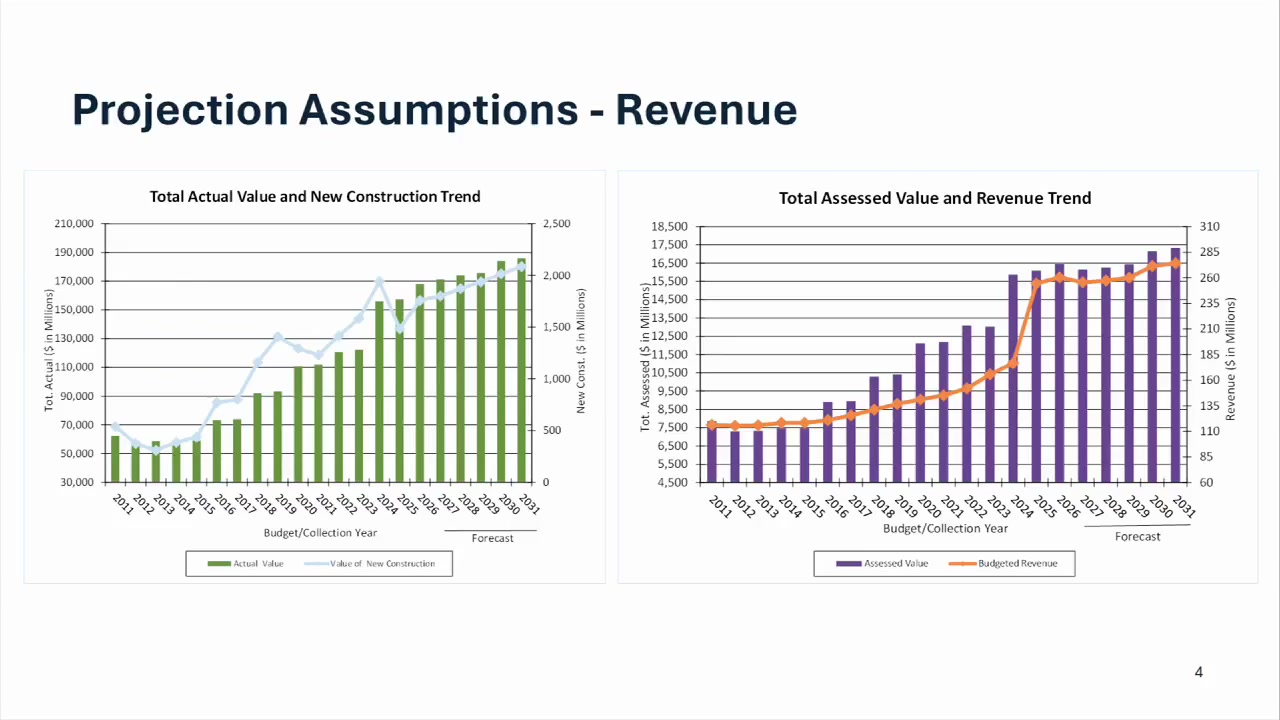
Arapahoe County is forecasting a roughly $5 million decline in property-tax revenue in 2027 — about twice the decrease officials previously expected — as rising costs and weaker revenue pressure several county funds.
Finance staff presented the preliminary forecast during the county commissioners’ Aug. 10 second-quarter budget review, a study session rather than a budget-adoption meeting. Preliminary 2027 assessed property values are expected to fall about 1.9%, producing an estimated $5 million property-tax decline instead of the previously projected $2.5 million drop. Final assessor information was expected later in August.
The preliminary 2026 General Fund forecast calls for $325.2 million in revenue, $310.1 million in expenditures and an ending balance of about $181.3 million, including $42.9 million in designated reserves, Finance staff told commissioners. The forecast includes at least $4 million in salary-and-benefit savings from vacancies and about $5 million in services and other expenditures staff did not expect to spend in 2026. Staff cautioned that much of those funds could be reappropriated in 2027.
Property-tax revenue is expected to remain mostly flat for several years, with a larger increase not anticipated until about 2030. Finance staff said the county has about $30 million remaining in one-time 1A funds to help cover ongoing costs, including salary and benefit increases, health insurance, contracts and future employee growth. One-time budget packages would be funded from ordinary fund balance rather than the 1A set-aside.
The preliminary 2027 General Fund forecast calls for $322.3 million in revenue and $315.9 million in expenditures. Expenditures are projected to exceed revenue from 2028 through 2030, before the anticipated 2030 property-tax increase helps close part of the gap. The forecast includes a $15 million annual General Fund transfer to the Capital Expenditure Fund through 2030, part of the county’s stated commitment to contribute $25 million annually to capital expenditures. Other ongoing budget packages are not included.
Several restricted or dedicated funds show more immediate strain, according to the county’s budget presentation:
- Road and Bridge: The fund is projected to have $29.3 million in 2027 revenue and $30.2 million in expenditures, with fund-balance draws continuing through 2031. Revenue assumptions include about $12.8 million annually from specific ownership taxes and $11 million from the Highway Users Tax Fund. Staff said future salary and benefit increases will require adjustments to keep the fund above its policy reserve.
- ALEA: Revenue is projected at $13.8 million in 2027, compared with $15.3 million in total uses. The fund’s balance is projected to fall from $7.8 million in 2026 to $1 million in 2029 and negative $2 million by 2031. Staff said ALEA is expected to fall below its policy reserve in 2029 and that the county may need to reconsider adding full-time employees. The fund had 21.5 vacancies at the end of the second quarter, up from 15 at the end of the first quarter.
- Social Services: The fund is projected to draw $4.1 million from its balance in 2027, with annual draws increasing to $11.2 million by 2031. Its projected ending balance falls from $10.9 million in 2026 to $800,000 in 2028 and becomes negative in 2029. Staff attributed the pressure partly to lower reimbursements for community-program contracts and said the fund would require adjustments based on available allocations.
The Capital Expenditure Fund was projected to have $27.1 million in 2026 revenue and $29.9 million in expenditures, with roughly $9 million in projects expected to be reappropriated to the following year. The forecasts identify pressure on staffing, benefits, capital transfers and dedicated funds, but do not establish current service cuts or reductions.
Supplemental and cleanup requests included $60,000 for a one-time $2-per-hour increase in election-judge pay, sheriff’s office operating and equipment changes, technology expenses, road and trail projects, and transfers for facilities and fleet needs. The Employee Budget Committee did not recommend several requests, including additional General Fund and ALEA money tied to a previously approved Sheriff’s Office position, more than $14,000 in District Attorney software costs and two off-cycle District Attorney positions. The committee said some costs could be absorbed within existing budgets or reconsidered during the full 2027 budget cycle.
Commissioners indicated they were comfortable moving the committee’s recommendations and other supplemental requests toward a public hearing scheduled for Sept. 8, 2026. The Aug. 10 study session did not adopt final budget changes or appropriations. The figures remain projections that could change after assessor data and the 2027 budget process are completed, the second-quarter budget review staff report says.