
Denver’s proposed 2027 budget holds growth near 1%, leaves reserves below target
Mayor Mike Johnston’s proposal would avoid a tax increase and raise reserves to about 12% of expenditures, below the city’s 15% policy target, while departments face grant and outside-revenue risks.
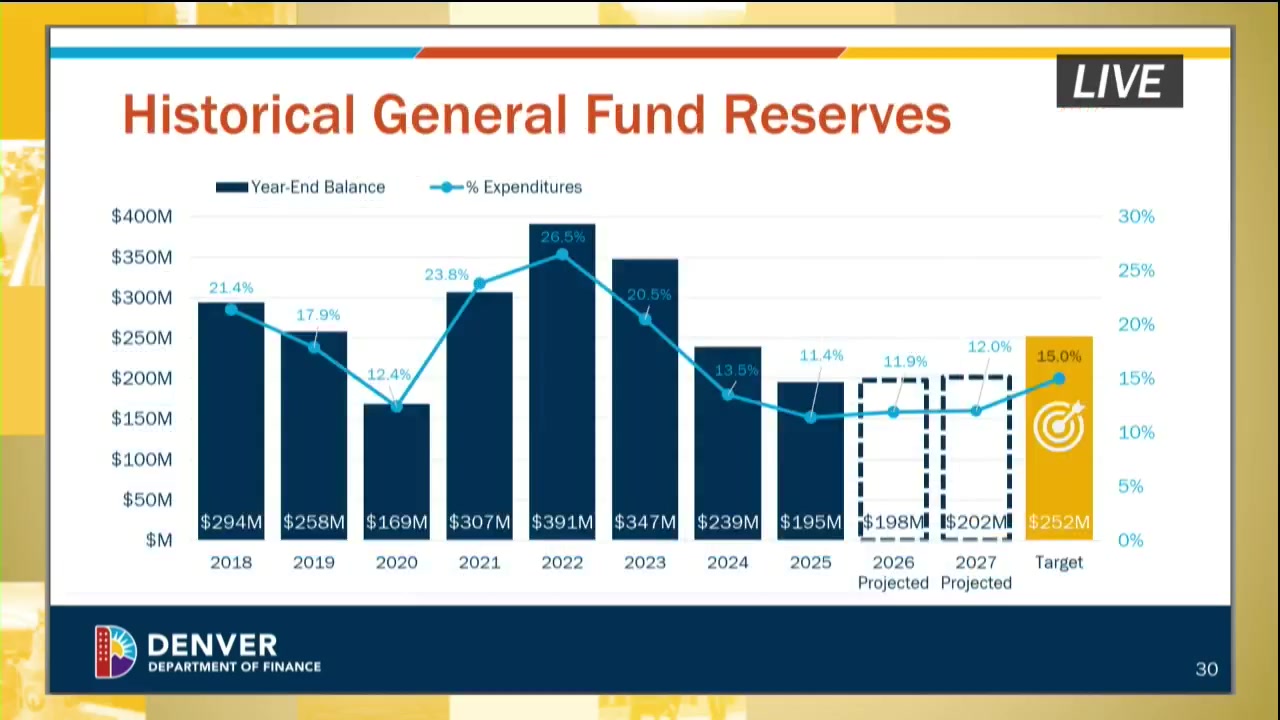
Denver Mayor Mike Johnston’s proposed 2027 budget would keep general-fund revenue and spending growth near 1% without raising taxes. It would increase reserves to slightly more than $200 million, or about 12% of expenditures, still below the city’s 15% policy target. Finance officials told City Council that the proposal anticipates about $1.684 billion in general-fund revenue.
The proposal projects about $971 million in sales-tax revenue, or 58% of the general fund, and approximately $187 million in property-tax revenue, or 11%. The city would keep its mill levy flat, although state changes are expected to reduce assessed property values. Officials cited consumer confidence, inflation, energy prices, geopolitical uncertainty and slowing grant activity as risks to the forecast.
The city projects reserves of about $198 million at the end of 2026 and slightly more than $200 million at the end of 2027. Reaching the 15% target would require roughly $252 million at projected spending levels, leaving a gap of about $50 million. The chief financial officer said reaching the target within two to three years is a goal, though another finance official did not give a specific year.
The operating plan includes a 2% merit increase for city employees and says the city would avoid layoffs and furloughs. It also includes $1 million to open the Westwood Recreation Center, additional support for the District Attorney’s Office and recruit classes for police, fire and the sheriff’s office. Grant expenditures are projected at about $321 million in 2027, while federal American Rescue Plan Act funds must be spent by the end of 2026.
Some departments warned that outside-funding changes could affect their budgets. Denver’s Department of Public Health and Environment said expiring federal grants could affect roughly 25 to 27 positions in 2027 and 2028. Its STAR behavioral-health response program includes 7.8 grant-supported positions and about $1.6 million from a Caring for Denver grant funded through at least July 2027. The department plans to seek renewal; the hearing did not establish that the positions or services will be lost.
The department also reported a 4% increase in residential complaints while managing a flat budget and seeking about $500,000 to fully staff the medical examiner’s office. Officials said monitoring would continue after a Kaiser grant for community air monitoring ended.
Denver Health told council that the proposed city funding does not include the roughly $3.9 million it requested for Denver CARES, a withdrawal-management and substance-use program. Denver Health said reducing the program could put about $8.5 million in related state and other funding at risk. No closure or reduction in hours had been approved as of the hearing.