
Commerce City district considers 8-mill levy that could pay debt three years early
The district board is scheduled to consider staff’s recommended 8 mills for 2027, which could pay off the debt three years early, or a 7-mill levy that would use fund balance for scheduled payments.
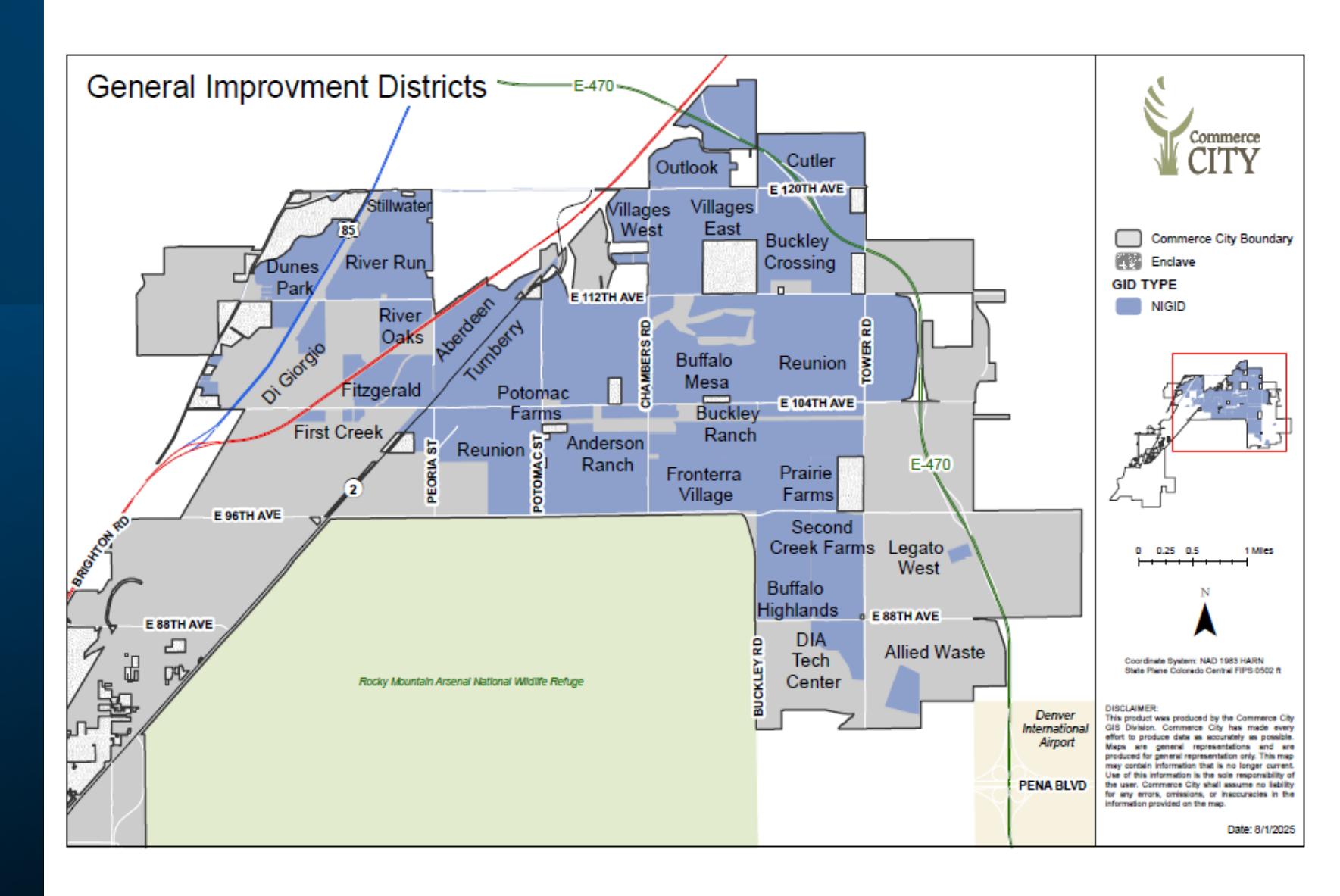
Commerce City’s Northern Infrastructure General Improvement District board is scheduled to consider keeping its debt-service property-tax levy at 8 mills for 2027 or lowering it to 7 mills. Staff says the higher levy could allow the district to pay off its bonds three years earlier than scheduled; the lower levy would rely more on fund balance for debt payments.
The board’s Sept. 28 agenda lists a presentation on the levy options and direction. A board communication describes the presentation as an effort to build consensus. Staff recommends keeping the levy at 8 mills.
Under that option, staff estimates the district could pay off its remaining debt in 2033 instead of 2036 and save $1.2 million to $1.3 million in interest. The presentation says the 8-mill levy would collect more than annual debt service, adding to the district’s fund balance. The alternative would reduce the levy to 7 mills for property taxes collected in 2027, lower it further in later years and use the fund balance to make debt-service payments on the existing schedule. The presentation lists Dec. 1, 2032, as the bonds’ call date.
The levy change would affect only the district’s portion of property taxes, not a taxpayer’s entire bill. The district’s preliminary 2027 budget estimates property-tax revenue of $5,199,603 at 8 mills and $4,549,653 at 7 mills, a districtwide difference of $649,950. One mill equals $1 per $1,000 of taxable assessed value, so the change for an individual property depends on its assessed value.
The budget calendar calls for the board to open and continue a public hearing on Oct. 19, 2026, then close it, act on the budget and certify the mill levy on Nov. 2.