
Arapahoe County water plan would require earlier supply reviews for development
The Planning Commission is scheduled to hear the proposal Oct. 20. County scenarios project 900,000 to 960,000 residents by 2050.
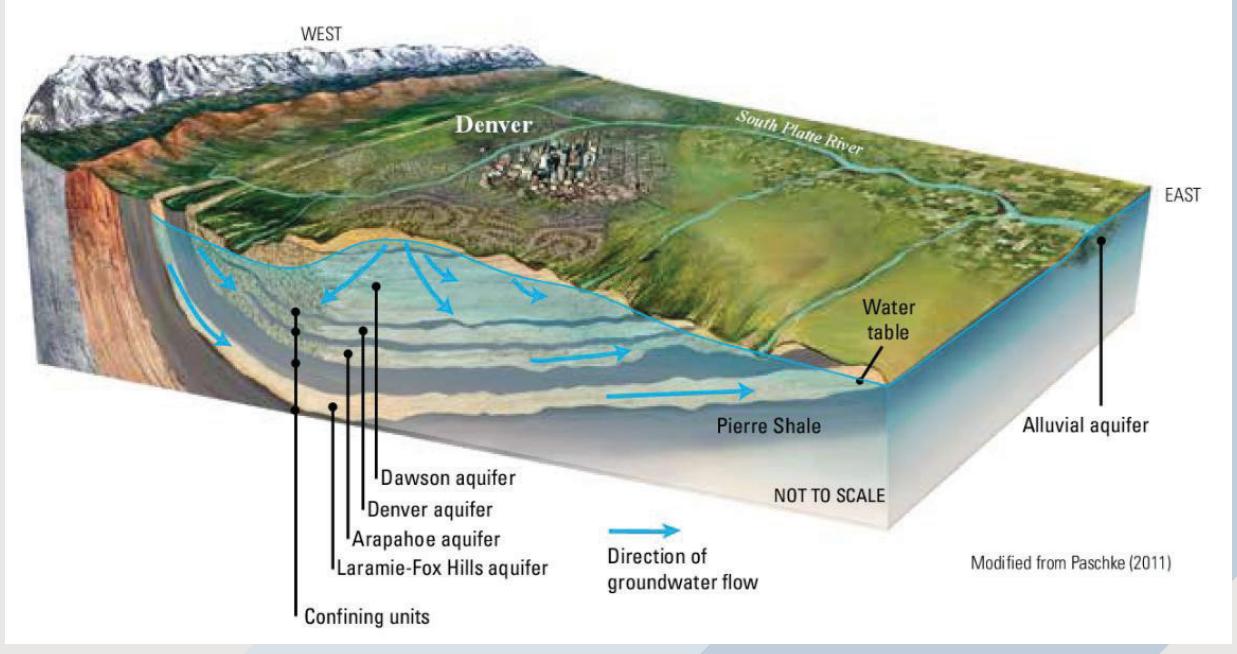
Arapahoe County’s proposed water-supply plan would require some development applicants to document water supplies earlier in county review. The Planning Commission is scheduled to hold a public hearing on the proposal Oct. 20.
At a Sept. 15 study session, staff presented two scenarios for 2050 growth: a “business as usual” scenario with 900,000 residents and 532,000 jobs, and a “hot growth” scenario with 960,000 residents and 595,000 jobs. The Planning Commission minutes describe them as scenarios, not a single forecast.
The county’s staff report and draft water-supply element say the update is intended to meet Colorado Senate Bill 24-174, which requires counties to adopt water-supply elements by Dec. 31, 2026, and update them every five years. The draft projects annual water demand of 115,996 to 124,769 acre-feet without conservation, or 101,490 to 108,497 acre-feet with modeled conservation measures.
The draft estimates that developed water supplies countywide will total 195,039 acre-feet per year by 2050. It also identifies projected gaps for some providers, underscoring that the countywide estimate does not resolve the needs of individual providers or projects. The county’s 2024 Water Supply Study identified projected gaps for some providers and supply issues for future development.
Under the proposed policies, applicants for rezonings, planned-unit developments, subdivisions and special-use permits would provide water-supply information earlier in the review process. The draft favors connections to existing public water providers and renewable supplies, calls for standardized documentation of adequate supplies, and encourages conservation, water reuse and efficient landscaping and building standards. It also proposes limits on isolated rural systems and new rural water districts in some circumstances.
The draft proposes using aquifer-specific production factors based on three-dimensional modeling to evaluate groundwater-dependent applications, rather than relying only on the state’s 100-year groundwater allocation formula. The proposed factors are 0.60 for the Denver aquifer, 0.42 for the Upper Arapahoe, 0.27 for the Lower Arapahoe and 0.71 for the Laramie-Fox Hills aquifer. The factors would reduce the groundwater counted as physically available in some development analyses. The draft describes Denver Basin aquifers as largely nonrenewable, with limited natural recharge, and says the Laramie-Fox Hills aquifer contains most of the basin’s potential supply but is more costly to develop.
The staff report projects shortfalls for Englewood and Inverness Water and Sanitation District under some 2050 demand scenarios. It says Englewood’s efficiency and demand-management measures are expected to address its projected gap. For Inverness, it identifies expanded Denver Water allocations, direct agreements and regional arrangements as possible options.
The report says only the first phase of Prosper Farms, involving 900 homes and about 180 acre-feet of annual demand, has been approved. Later phases would need to document additional renewable supplies and reuse before proceeding, according to the county.
The water proposal is proceeding alongside proposed transit-area rezonings. County staff previously estimated that maps covering Federal Enclave, Dry Creek/Inverness, Four Square Mile and Belleview could accommodate about 36,765 homes, compared with a county-reported goal of roughly 19,000. Those estimates remain preliminary, and future projects would still face site-plan, traffic, drainage, water and sanitation review.
The county requested comments on the draft by Oct. 1. Commissioners discussed the proposal at the Sept. 15 study session but took no vote or recommendation, according to the minutes. A Sept. 21 staff report to the Board of County Commissioners describes a Nov. 24 board hearing as tentative and as the next step toward formal adoption. The state deadline for adoption is Dec. 31, 2026; if adopted, the draft would be reviewed every five years, with the first full update planned before the end of 2031.