
Denver says recurring E. coli remains main stream-water warning as drought raises summer risks
City health officials told council that Denver’s streams are generally in good condition overall, but recurring E. coli remains the clearest problem as low flows and heat can worsen algae growth, fish stress and pollutant concentrations.
Published at
Denver health officials told council Tuesday that the city’s streams are generally in good condition overall, but recurring E. coli remains the main water-quality warning sign as drought threatens to intensify summer heat, algae growth and fish-stress risks.
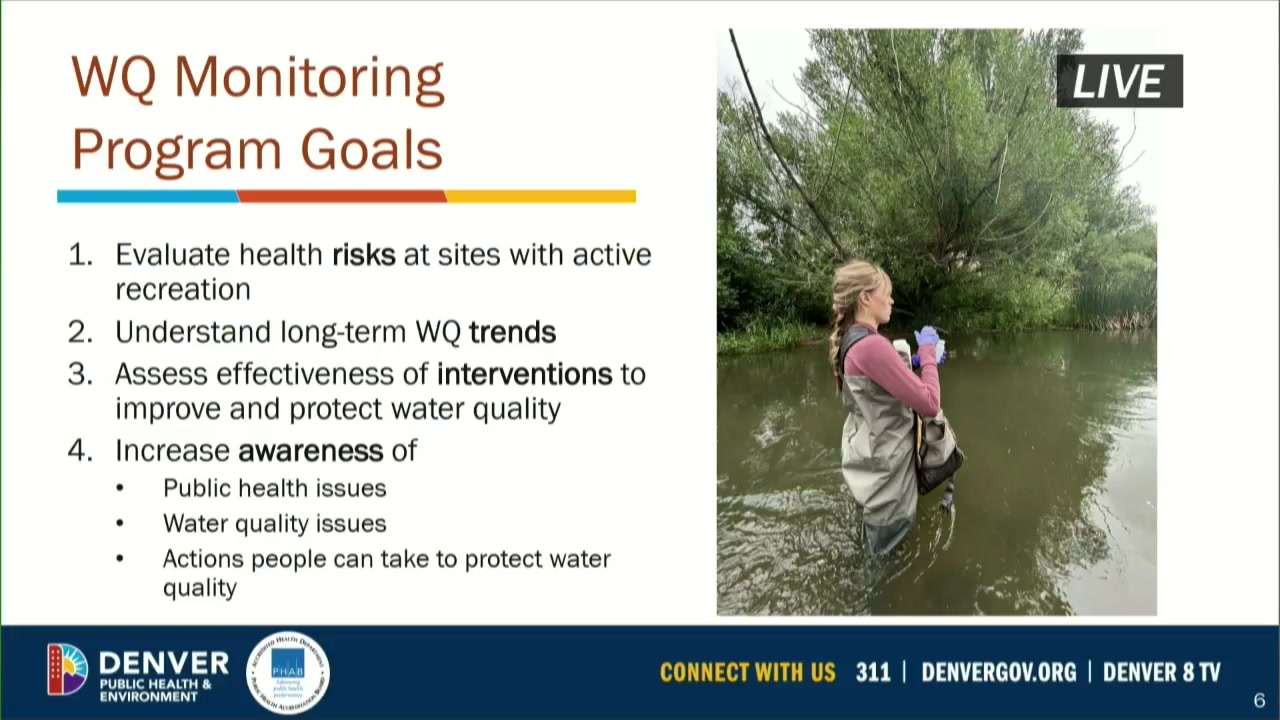
At the June 10 South Platte River Committee briefing, Denver Department of Public Health and Environment staff said lower streamflows can mean higher water temperatures and more concentrated pollutants. Staff also said drought can increase algae growth and fish die-offs in lakes, and that stormwater runoff remains a major pollution source because it reaches waterways without treatment.
The timing matters because Denver Water told council in a separate May 13 drought briefing that 2026 snowpack and water-supply conditions were the worst in the utility’s historical record, with South Platte Basin snowpack already melted out and the system relying heavily on reservoir storage.
Denver already tells residents that it does not recommend swimming, wading or playing in city streams or lakes, even when recent sampling does not trigger a new advisory. The city says urban runoff and discharges can carry bacteria including E. coli, and warns that hot, dry weather makes blue-green algae blooms more likely in many lakes during summer.
On the bacteria issue, staff’s June 10 presentation described Denver streams as generally in good condition except for repeated E. coli concerns. The city’s water-quality program page says Denver samples streams year-round and compares results with state criteria, while lakes are usually sampled once each summer.
City lake summaries show that heat-related risks vary by water body. In Duck Lake’s 2025 summary, Denver said dissolved oxygen, ammonia, copper and pH have at times been marginal to poor over the past decade, with warm temperatures, shallow depths, nutrient-rich runoff and excessive plant and algae growth contributing to fish stress. The report said improved aeration helped oxygen levels meet standards in recent years, but recommended continued algal screening and possible cyanotoxin testing.
In a 2025 Parkfield Wetland summary, the city said pH and dissolved oxygen can drift out of compliance in part because of shallow water, organic sediments, temperature and heavy plant and algae growth. In Ferril Lake’s 2025 summary, Denver said aeration and mixing appear to be helping keep dissolved oxygen and pH within standards during recent mid-summer sampling.
Council members also asked about contaminants that residents increasingly raise: PFAS, microplastics and pharmaceuticals. According to the June 10 briefing, officials said PFAS is not part of Denver’s routine surface-water sampling largely because of cost, microplastics are being studied with a Colorado School of Mines doctoral student, and the city is working on a public-facing dashboard after an earlier version was taken down.
The briefing did not indicate a firm relaunch date for that dashboard, and the public city pages cited in this story do not provide one. For now, Denver’s recreation guidance remains the clearest public warning heading into summer: urban waterways can pose health risks, especially when bacteria and algae rise in hot, low-flow conditions.