
Denver panel advances entertainment-license rewrite with 4 a.m. nightlife option
A committee-backed overhaul would replace 14 entertainment license types with three, drop permits for some low-impact activities and add new safety rules for late-night venues.
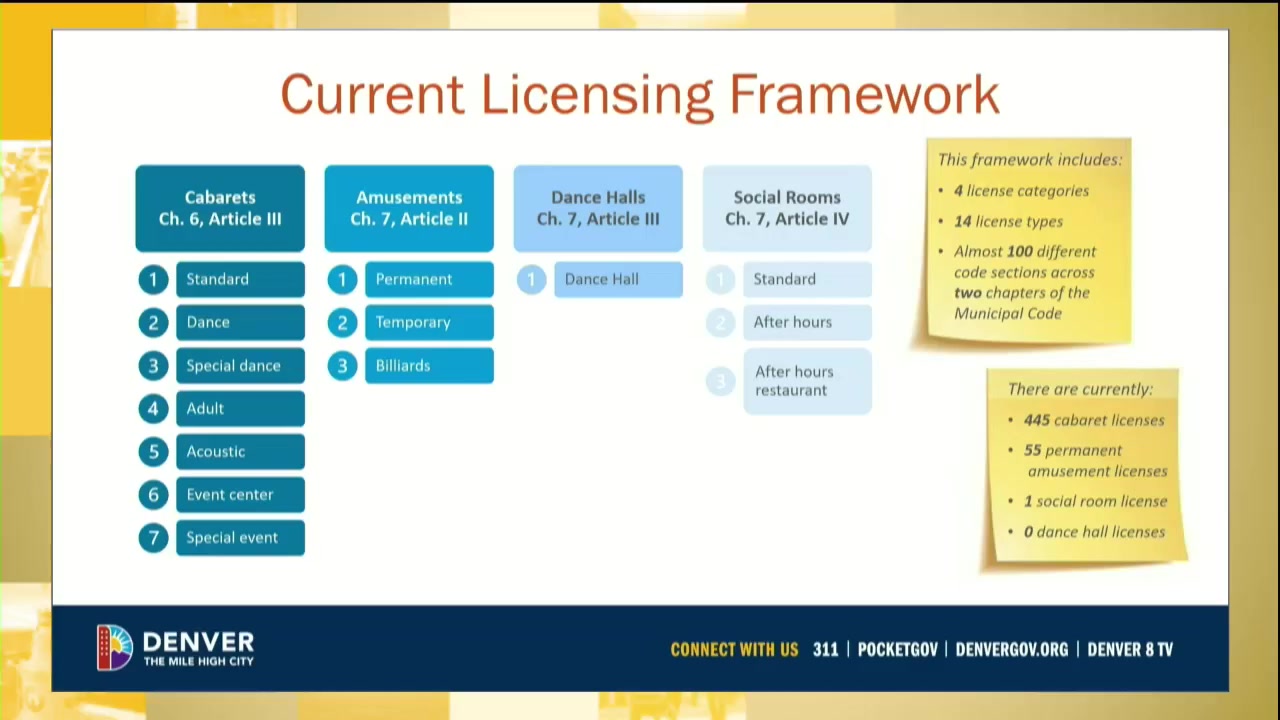
Denver’s Finance and Business Committee voted 6-0 on June 23 to advance a rewrite of the city’s entertainment-licensing code that would replace 14 license types with three broader categories, drop permits for some low-impact activities and add new safety requirements for late-night venues. Councilmember Chris Hinds was absent, according to committee minutes.
Licensing staff told the committee the proposal would create limited entertainment, nightlife entertainment and adult entertainment licenses in place of the city’s current amusement and cabaret categories. Under the draft presented June 23, trivia, bowling, movie theaters and ambient or background music would no longer need standalone entertainment licenses.
The committee-approved draft would keep a late-night provision allowing nightlife and adult-entertainment businesses to continue entertainment until 4 a.m., while alcohol service would still have to stop at 2 a.m. under state law, staff said. For limited-entertainment businesses, venues that usually operate before midnight could extend to 2 a.m. up to 12 times a year with notice, staff said.
Staff said in their presentation the bill would remove licensing requirements for lower-impact activities while requiring nightlife and adult-entertainment venues to follow rules on disorderly-conduct prevention, patron dispersal, security planning, video surveillance, record-keeping and approved managers who pass background checks. The proposal would also bar weapons at those businesses, though staff said before filing they expected to add language exempting licensed armed security guards and law enforcement.
Council members and public commenters questioned whether some of the new rules are too broad. During the hearing, council members raised concerns about the proposal’s 25-foot crowd-dispersal standard, the city’s justification for 4 a.m. operations and how future rulemaking would be opened to public scrutiny. Council President Amanda P. Sandoval said the rulemaking section concerned her most, while Councilmember Darrell Watson and others asked how neighborhood input would work if the city moves away from mandatory hearings in most cases.
Privacy questions also surfaced around records tied to adult-entertainment businesses. Staff and the city attorney told the committee they were not seeking entertainers’ personal information and said the books-and-records language was limited to requests from law enforcement or city officials. Even so, council members signaled they wanted clearer guardrails before final passage.
Staff told council more amendments were planned before filing, including tighter language on neighborhood resident support, the weapons exemption and other implementation details. The same presentation said registered neighborhood organizations would get 30 days, instead of 20, to request a hearing.
The next steps were still unclear as of June 26. At the June 23 meeting, staff said the bill was expected to be filed July 9 and heard by the full council July 13 if that timeline held. But Badger could not verify from the official records available for this assignment whether the bill had been filed, amended again or scheduled for final council action.
For now, the clearest public record is the committee-approved version: a licensing simplification that keeps the 4 a.m. entertainment option, preserves the 2 a.m. alcohol cutoff and leaves unresolved how far Denver will narrow surveillance, record-keeping and other compliance requirements before full council review.