
Denver’s 311 street-engagement closures often mean no one was there — not that the problem was solved
A City Council briefing showed Denver’s one-business-day closure goal is measured largely by whether a reported person or condition remains at the location, while service, enforcement, arrival-time and staffing data remain incomplete.
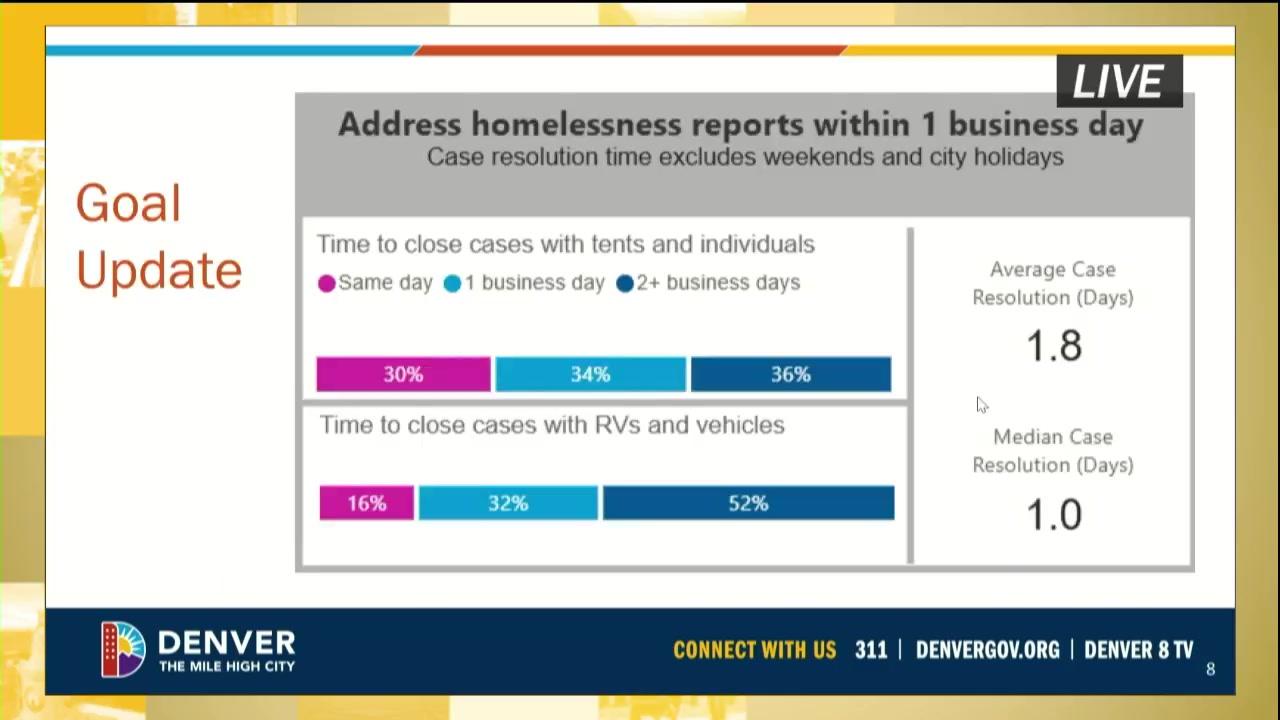
Denver officials told City Council on July 15 that the city closes street-engagement cases when a person or condition is no longer at the reported location, even if the underlying problem may not be resolved. The briefing highlighted a gap between the city’s one-business-day closure goal and the outcome data available to the public.
The system routes nonemergency homelessness, disorder, trash and related reports through 311. City and community agencies review cases each morning and assign them through Salesforce to teams including housing stability, behavioral health, public health, police, transportation, parks and street ambassadors, officials told the council.
Erin Atencio of the mayor’s office said the goal is “to close every ticket within one business day.” Megan Roar said cases closed in an average of 1.8 days and teams generally made contact within 24 to 36 hours. But the system does not record when a field team arrives.
That makes the closure measure different from a service outcome. Roar said a case is closed when “someone is no longer at that location.” Officials said no one was still there in about 70% of cases. When someone was present, a service was offered and accepted about 34% of the time. The briefing did not provide a breakdown of enforcement, shelter, housing, behavioral-health care, sanitation or other outcomes.
The figures do not establish an overall service-connection rate: 34% applies only to visits when someone was present, while 70% describes locations where no one was found. The system’s on-hold, complete and transferred labels also do not show whether help was received or a recurring condition was addressed.
The city reported nearly 2,500 calls and 38 survey responses during the briefing, a response rate of about 1.5%. Officials said they review responses monthly, but the public record does not identify the survey period, sampling method or instrument, limiting what the survey can show about satisfaction.
A Denver Auditor review offers broader 311 context, not a direct measure of street engagement. It found that 59% of general 311 cases were resolved at first contact and 41% routed to an agency, and documented closure categories such as duplicate cases that can leave the original request pending.
What Denver says it will measure next
Officials said the city plans to add a field-arrival timestamp among roughly 11 process and data changes, allowing it to distinguish assignment time from arrival time. Denver also wants more detailed quarterly reporting on RV cases, including impounds and other legally permitted actions. Data is split among Salesforce, the Homeless Management Information System, police dispatch and behavioral-health and clinical systems. Officials cited privacy and HIPAA restrictions as barriers to linking them; a monthly group of system owners is considering manual or integrated data options, with a recommendation expected by the end of 2026.
Staffing and funding
The briefing did not produce a single 2026 cost for the operation. Roar cited an inventory of roughly 130 to 140 people, including part-time workers and staff assigned to particular locations. Councilmember Torres cited 84 current staff and 94 authorized positions in an appendix and asked whether all 94 were budgeted. Officials said the work is distributed among existing teams, making its staffing and cost difficult to isolate.
Denver’s 2025 adopted budget lists the Street Engagement Team at 12 positions and about $1.015 million in recommended spending. The 2026 proposed budget also lists 12 positions. A separate $5.8 million Housing Central Command allocation is broader homelessness-response funding, not a cost for 311 triage.
For now, Denver can report how quickly cases are assigned and whether a location is clear when a team arrives. It cannot yet show, case by case, whether a closure represents a service connection, lasting cleanup, enforcement or only the disappearance of the reported issue.