
Denver committee advances $1.6 million Federal Boulevard transit-oriented development contract
The 5-0 vote moves forward an 18-month planning process funded through a broader $2 million federal award; zoning changes and anti-displacement tools have not been adopted.
Published at
Denver’s Community Planning and Housing Committee voted 5-0 July 14 to advance a Federal Boulevard equitable transit-oriented development plan as the city prepares for bus rapid transit-related changes along the corridor.
The committee approved Council Bill 26-1024 for filing. The bill authorizes a $1.6 million agreement with HNTB for consultant services through Aug. 31, 2029, covering the Federal BRT corridor in Council Districts 1, 2, 3 and 7, the bill record shows.
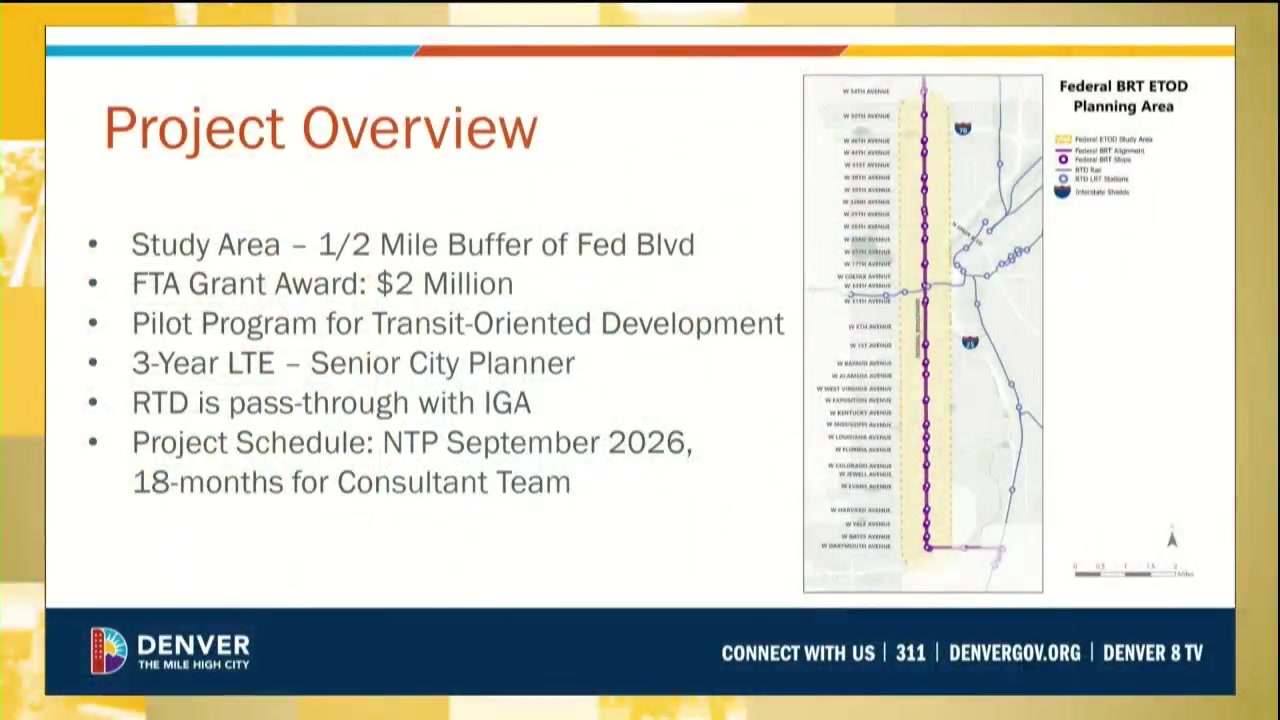
The agreement is separate from the $2 million Federal Transit Administration award described in the committee presentation. Staff said the Regional Transportation District is passing the federal money through to Denver because the city is not the direct grant recipient. The record does not support treating the award as a second consultant contract.
Work is expected to begin in September and take about 18 months. Staff said a three-year city planning position will continue beyond the consultant work to help deliver a regulatory package. The project covers Federal Boulevard within Denver and a half-mile buffer on each side.
What the plan could change
Staff described the effort as an implementation process for existing neighborhood and small-area plans, not a new adopted neighborhood plan. It could eventually produce zoning-text or zoning-map amendments and other regulatory changes, but none have been proposed or adopted.
The consultant scope includes an equitable transit-oriented development policy strategy, analysis of specific development sites, infrastructure planning, a regulatory-framework assessment and first- and last-mile connections. It will also examine ways to preserve Federal Boulevard’s cultural significance, according to the city’s committee presentation.
Council members urged staff to develop concrete protections against displacement. Ideas discussed included:
- small-business displacement funds;
- a revolving-loan or business-support fund, possibly through a BID or BIO;
- assistance modeled on Washington, D.C., including a first right to return for displaced businesses; and
- coordination of existing housing and business tools, including a HOST property-tax rebate and a business-aid fund that one council member said is not formalized in city code.
The committee did not create those programs. The meeting record does not establish eligibility rules, funding sources, dollar amounts or a final anti-displacement package.
Engagement and agency coordination
Staff described a targeted engagement process with residents, businesses and others likely to be affected. It is expected to include in-depth conversations, focus groups, a project website, community navigators and coordination with council offices to identify participants.
The city’s Federal Boulevard project overview describes the corridor plan as a guiding document for Denver, the Colorado Department of Transportation, RTD and other stakeholders. Denver’s Department of Transportation and Infrastructure says it is coordinating with CDOT and RTD on corridor improvements, including traffic-signal upgrades and transit-signal priority.
The public record does not provide a detailed division of responsibilities among Denver, RTD and CDOT for the HNTB contract. Any future zoning amendments, business-support programs or anti-displacement requirements would require later city decisions.