
Denver council advances entertainment-license rewrite in 10-1 publication vote
The proposed rewrite would replace 14 entertainment-license types with three, but worker-privacy, surveillance and neighborhood-impact provisions remain unresolved before a final vote.
Published at
Denver City Council voted 10-1 July 13 to order publication of a proposed rewrite of the city’s entertainment-licensing code, advancing the measure beyond committee review but not adopting it. Councilmember Amanda Sawyer opposed the vote. The council’s meeting record identifies the measure as Council Bill 26-0921.
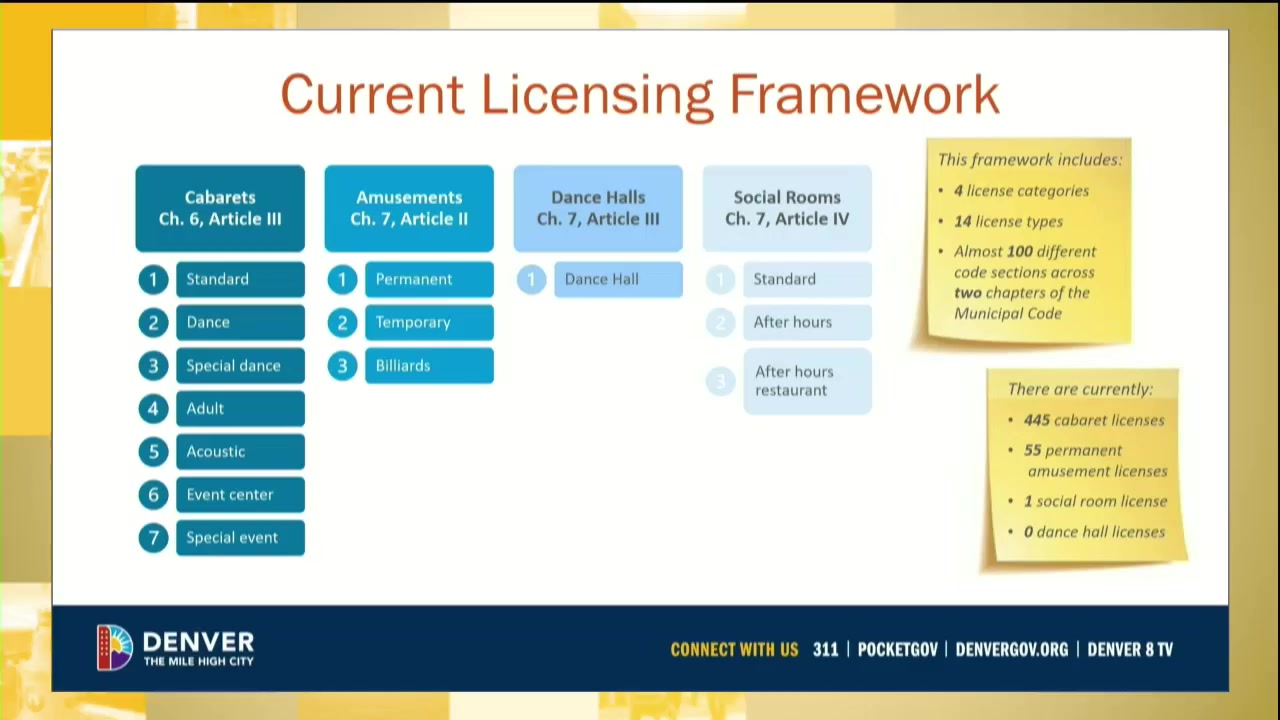
The bill would replace 14 license types with three broader categories: limited entertainment, nightlife entertainment and adult entertainment. It would remove standalone entertainment-license requirements for some lower-impact activities, including trivia, bowling, movie theaters and ambient or background music. It also proposes safety and compliance requirements for nightlife and adult-entertainment businesses.
The proposal would let nightlife and adult-entertainment businesses continue entertainment until 4 a.m., while alcohol service would still have to stop at 2 a.m. under state law, licensing staff told the Finance and Business Committee. Limited-entertainment businesses that usually operate before midnight could extend to 2 a.m. up to 12 times a year with notice, under the committee draft. The committee voted 6-0 June 23 to advance the bill; Councilmember Chris Hinds was absent, according to committee minutes.
At the July 13 meeting, Councilmember Serena Gonzales-Gutierrez said she and city staff were developing amendments in response to concerns from entertainment workers and civil-liberties advocates. She said a possible change to the records section could better protect workers’ safety and privacy while retaining department-required record-keeping. She also said surveillance language should expressly protect spaces where recording is legally prohibited, including dressing rooms and bathrooms.
Erica Rogers, deputy director of the Department of Licensing and Consumer Protection, said the department intended to require only enough video surveillance to investigate alleged violations and that details could be addressed through public rulemaking. Gonzales-Gutierrez said she expected to bring possible amendments at a later council meeting. The draft also covers disorderly-conduct prevention, patron dispersal, security planning, records, approved managers who pass background checks and weapons restrictions. Staff previously said they expected to add an exemption for licensed armed security guards and law enforcement before filing.
Sawyer said the late-night provisions could create noise and other impacts in neighborhoods where entertainment businesses are near homes. She cited Cherry Creek, Lowry and Colfax and questioned whether rules designed for downtown would work near residents who are sleeping. Council members also had questioned the draft’s 25-foot crowd-dispersal standard, the justification for 4 a.m. operations and how future rules would receive public scrutiny. Council President Amanda P. Sandoval said the rulemaking section concerned her most.
The publication vote allows the bill to proceed to later council consideration; it does not make the rewrite law. The record available for this update does not establish a final passage date or the final text of the worker-privacy, records, surveillance or neighborhood provisions.