
Denver weighs tax or fee to close transportation funding gap
Officials say fully building out and maintaining Denver’s long-range mobility plan would cost about $600 million a year, but the city has not settled a revenue proposal or project priority list.
Published at
Denver transportation officials say fully building out and maintaining the city’s long-range mobility plan would cost about $600 million a year, compared with the $200 million to $300 million typically available for transportation. A possible permanent tax or fee was not ready for council action Wednesday.
The proposal remains under discussion, Councilwoman Diana Romero Alvarez-Kicasa said during the July 15 Transportation and Infrastructure Committee briefing. Officials have not settled the type or rate of a tax or fee, and the committee took no formal funding action. Finance staff said a citywide fee study is beginning and the city expects more information in the coming weeks and months, but officials gave no date for ballot language or advancing a revenue measure. The briefing also included requests for written answers, clearer project-level spending information and follow-up discussions.
The funding question matters because Denver Moves Everyone is not a construction program with dedicated revenue. Department of Transportation and Infrastructure staff said Safe Routes to School and Vision Zero work is spread across pedestrian, paving, bicycle, signal, transit and other asset programs, using federal and state grants, gas-tax distributions, local property-tax and general-fund dollars, parking-meter revenue, sidewalk enterprise funds, bonds and fees.
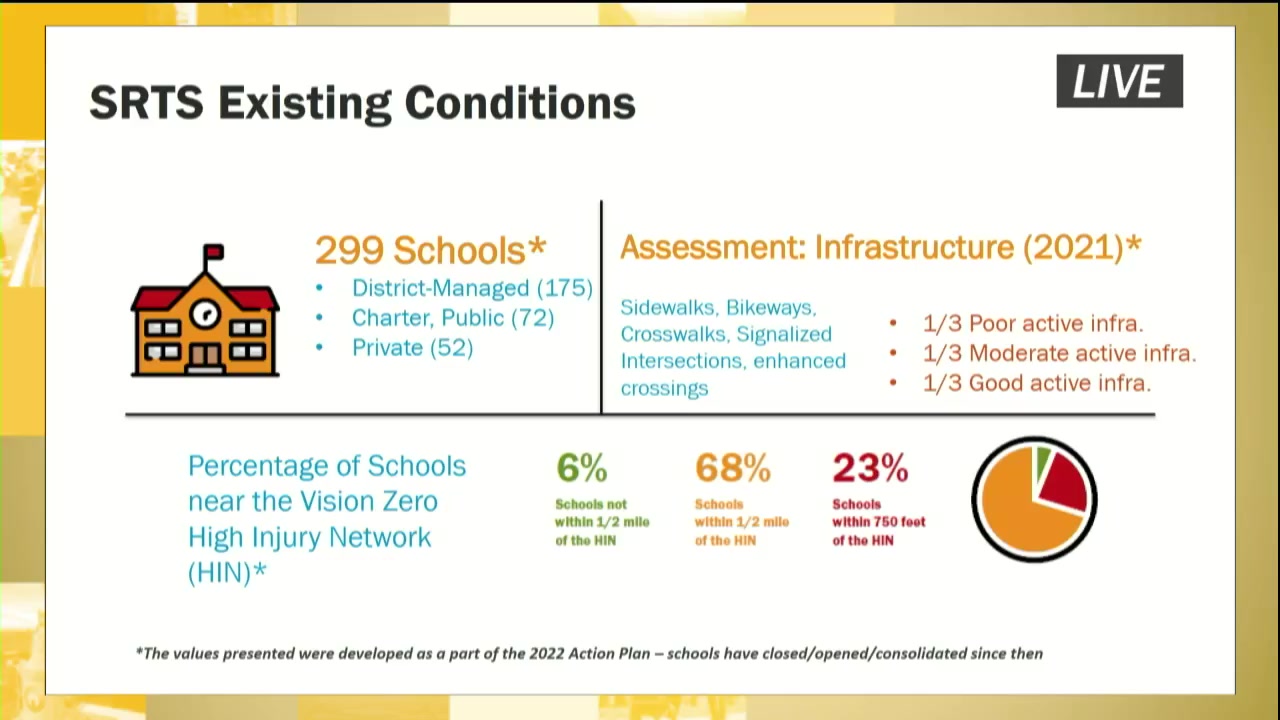
If funding remains below the plan’s needs, the clearest priority rules discussed were for schools. Denver’s Safe Routes to School action plan identified 108 of 299 schools in designated Equity Areas of Need with medium or high traffic-safety concerns. It placed those schools in four priority tiers. Within each tier, schools directly on the city’s High-Injury Network ranked ahead of others. For schools not directly on that network, the plan used the amount of High-Injury Network within a half-mile radius, with SchoolChoice percentages breaking ties.
That framework is not a neighborhood-by-neighborhood construction schedule. Staff described Denver Moves Everyone’s equity approach as citywide while emphasizing the High-Injury Network, neighborhood collector streets, transportation-equity priority areas, high-frequency transit corridors and places where sidewalks, bike routes and transit connections are incomplete. The Denver Moves Everyone strategic plan defines the equity areas as places where residents face greater transportation inequities and where DOTI intends to focus investment.
The six-year outlook through 2032 includes 36 school travel-plan studies, more than $200 million in sidewalk repair, construction and widening, at least 60 crossing improvements, and 18 to 30 flashing school-zone beacons. Travel plans can lead to traffic calming, bicycle connections, safer crossings and changes to education or operations, but staff did not identify which projects would be funded first if money is unavailable.
Council members cited examples of safety needs. Councilman Chris Flynn pointed to a crossing at Dennis Harrison Elementary School near Yates and Jewel streets, just outside Harvey Park’s northwest corner, as his top Safe Routes concern and said it may need a rapid-flashing beacon or similar treatment. He also cited unresolved concerns around Teller Street. Staff discussed beacon work at 13th and 14th streets and pointed to safety improvements near Dayton as an example of Highway Safety Improvement Program work on a state-owned arterial. Those locations were raised during the discussion, not adopted as a citywide priority list.
For now, the city is describing a planning and revenue-development process rather than a funded expansion. The next steps are the fee study, additional projections, coalition-building and public discussion. Until those steps produce a proposal, Denver has targets for safer school routes and better-maintained sidewalks but no approved mechanism to provide the $300 million to $400 million in additional annual funding staff say full build-out and maintenance would require.