
Denver reports faster permit reviews, but Prop 123 results remain hard to audit
The city says 88% of permit reviews were on time through July 8, but it has not published project-level counts or metric definitions needed to assess the fast-track program.
Published at
Denver says permit reviews are getting faster, but the city has not published a reproducible project or unit count — or the full methodology behind its headline metrics — making it difficult to determine how many affordable homes its Proposition 123 fast-track program is advancing.
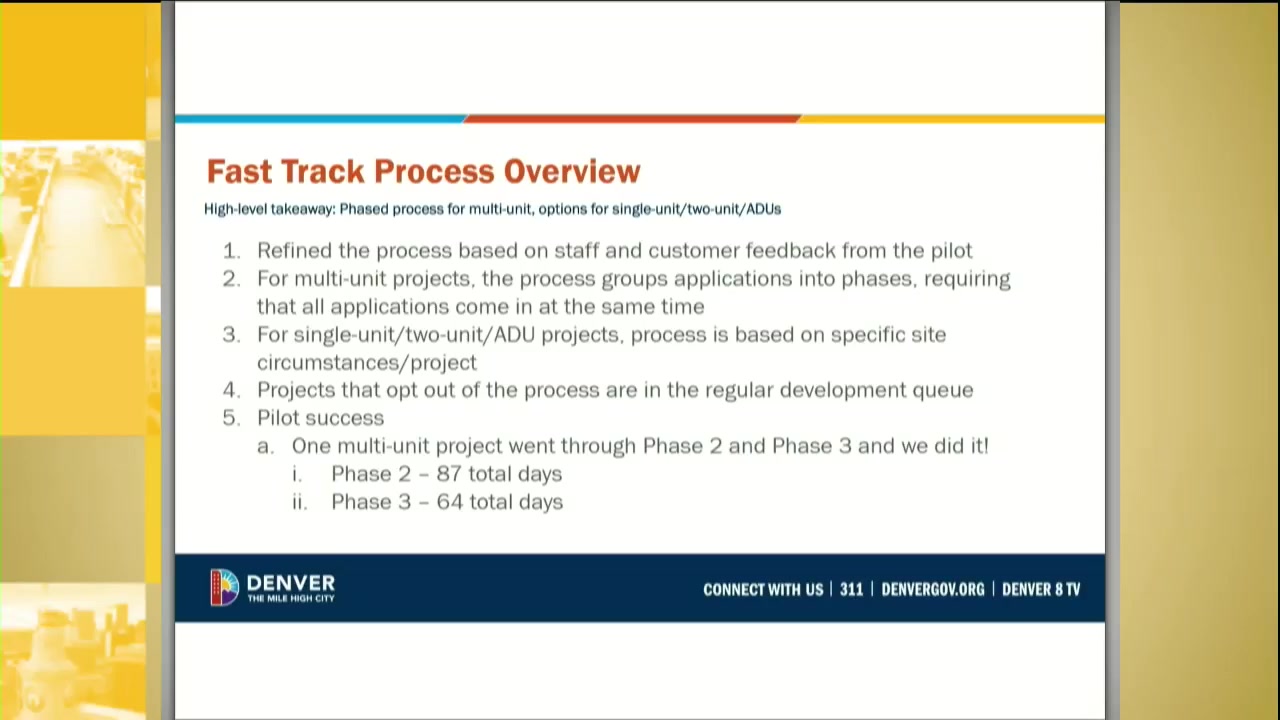
The process formally launched June 22 after a pilot period, the city said. City officials told the Denver City Council’s Community Planning and Housing Committee on July 14 that they aim to support about 1,800 units by the end of 2026 through the fast track and Affordable Housing Review Team processes.
That is a goal, not a published count of units already in the pipeline or approved. City guidance says qualifying affordable residential projects can use the fast track even without Proposition 123 funding, but provides no current project list or running unit total.
What the city is measuring
Permitting officials told the committee that 88% of permit reviews logged into city review were on time through July 8, up from about 76% at the end of 2025. The figure excludes two-day minor express reviews, and the city did not publish the numerator, denominator, project mix or other calculation details. The July 14 committee video documents the presentation and discussion.
Officials also said five active projects had reached 180 calendar days of city review without a refund. Two had been approved within the period allowed by an executive order, one was a zoning-only project with no plan-review fees, and two remained in process, according to the briefing. That measure is separate from Proposition 123’s 90-day process, which includes both city and customer time.
The office said its “one-and-done” concept site-plan process reduced average review rounds from 1.9 in 2025 to 1.3. Council members asked for more information on application volume, intake turnaround, review rounds and approved units by project and housing type. Those data were not included in the briefing materials or found in a public project-level dashboard.
Where delays persist
Councilmember Amanda Sawyer said vacations and Tier 3 right-of-way encroachments remain major bottlenecks because they involve multiple city agencies. She said two District 5 developments totaling more than 500 units lost financing after prolonged vacation reviews. The meeting record does not name the developments, document their individual unit counts or independently establish that the reviews caused the financing losses.
Denver’s Proposition 123 process description places right-of-way vacations and Tier 1, 2 and 3 encroachments in the site-work and engineered-document phase. City requirements say the City Council legislative process for a Tier III encroachment takes about six weeks or longer if council action is delayed, and that council can deny a request.
Staff told council they were testing ways to run vacation reviews in parallel with other work, including a pilot tied to a National Women’s Soccer League project. Until those changes produce comparable public data, the 88% on-time figure does not show how projects requiring interagency approvals are performing.
Access remains a separate test
The city’s permitting website offers multiple language options, but it has not published Prop 123-specific information showing which application materials, linked documents or assistance are available in each language. Councilmember Serena Gonzales-Gutierrez said a StartSmart residential tool did not switch correctly to Spanish when she tested it. A staff member said the tool had translated properly in testing and agreed to check the issue.
Denver has reported improved timeliness and a unit target, but not the project-level data needed to assess who is using the fast track, how many units have advanced, which projects remain delayed or whether access is equal across languages. A useful next accountability step would be a regularly updated dashboard defining each metric and listing applications, review status, units, delays, refunds and project type.