
Jeffco considers possible November levies totaling about $133 million
Jeffco’s financial outlook projects shrinking spendable reserves and at least $53 million in reductions and capital deferrals without new revenue; the board has not adopted levy amounts or ballot language.
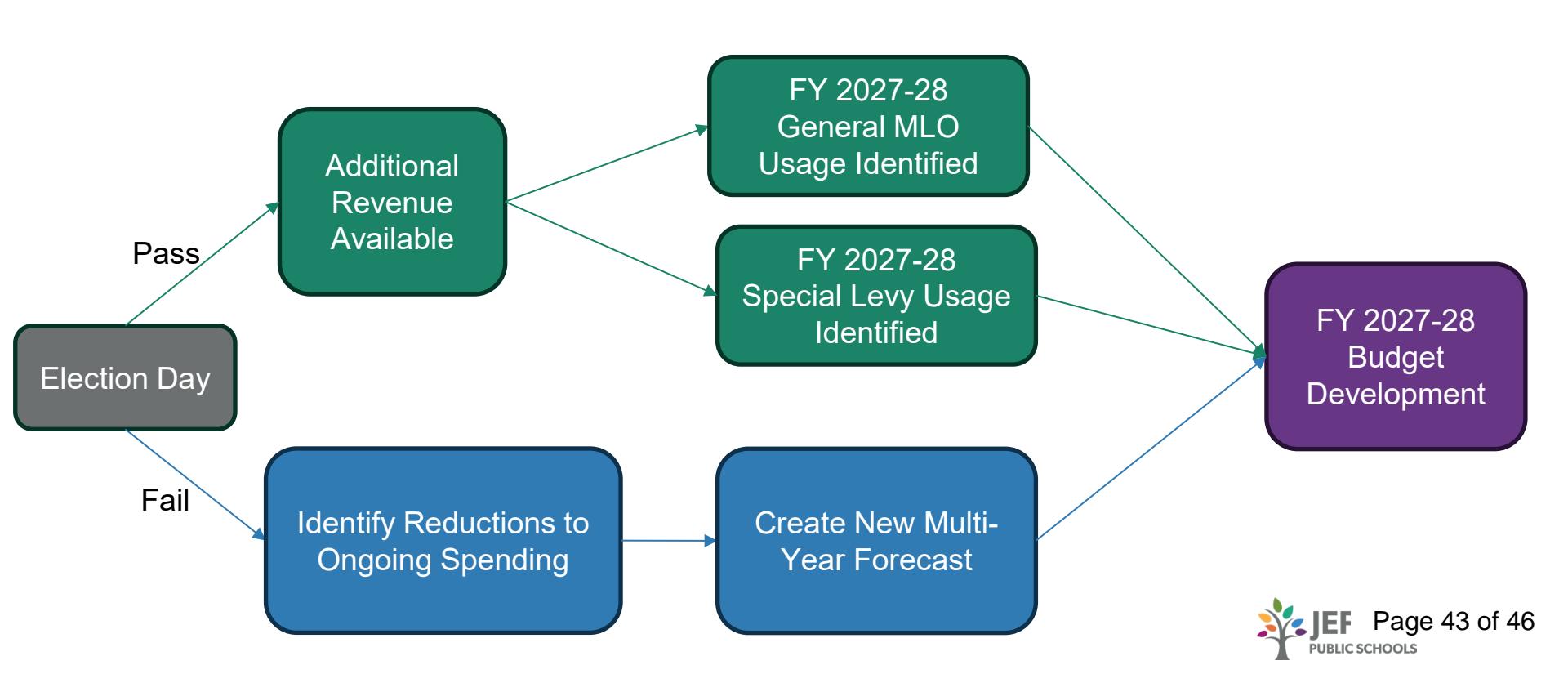
Jeffco Public Schools is weighing four possible November 2026 revenue scenarios, including two draft mill levies that could raise about $133 million annually if combined. The school board has not selected or formally advanced an option.
The district’s adopted 2026-27 budget assumes no new levies. An Aug. 4 financial outlook shows approximately $977 million in general-fund revenue against $991 million in expenditures and transfers. Without new levies or other changes, spendable general-fund reserves are projected to fall to about $62 million by June 2028, with about $9 million in spendable capital reserves, district materials show.
The four scenarios are no new levies, a general-purpose mill levy override, a special-purpose levy for capital and other needs, or a combined package. The presentation estimated about $73 million annually from the general-purpose override and used an illustrative $60 million for the special-purpose levy. Those are separate potential measures, not one levy, and both would require voter approval.
The draft measures are labeled Ballot Issue 5[A], for general purposes, and Ballot Issue 5[B], for capital, maintenance and technology needs. The July 24 retreat materials contain no vote authorizing ballot placement or adopting either measure. The Aug. 4 materials likewise describe the amounts and language as proposals under development.
If voters approve a measure in November, the materials say the additional mills would be certified in December, collected through 2027 property taxes and begin generating cash from March through August 2027. The first full budget year for the revenue would be 2027-28. A district estimate puts the cost of a $75 million general-purpose override at about $1.21 per month per $100,000 of actual home value, and a combined $135 million package at about $3.58. Those figures are illustrative, not final tax bills; the materials do not provide a separate business-tax estimate.
The combined scenario would direct general-purpose revenue to charter-school sharing, previously awarded and future compensation and benefits increases, and career and technical education. The special-purpose measure would support charter-school sharing and capital maintenance, facility improvements and building systems. Jeffco says it spends about $108 million annually on facilities, compared with an industry benchmark of roughly $110 million. Proposed work includes HVAC and cooling systems, roofs, plumbing and sewer lines, parking lots, asbestos abatement, drinking-water systems, security and aging technology; replacing R22 refrigerant in 96 buildings is identified as a priority.
Without new revenue, the district says it would continue under the approved 2026-27 budget and plan at least $18 million in General Fund reductions and $35 million in additional capital-maintenance deferrals for 2027-28. Possible responses include salary freezes, changes in benefit funding, staffing and programming reductions, shorter work calendars and additional school closures. The district has not identified which employees, programs or schools would be affected.
The board approved the budget June 11, including a $13.1 million General Fund reserve authorization for compensation increases and a tentative teachers-union agreement. The board agenda materials show a General Fund appropriation of about $1.058 billion, including $67.3 million in reserves. Director Denine Echevarria cast the lone no vote on the budget, reserve-use resolution and tentative agreement, saying during the meeting that she could not support “another deficit budget.”
The district’s budget-reduction blueprint says the board would consider placing a measure before voters in November. The Aug. 4 materials preview possible action at the Aug. 20 regular meeting, including ballot-language certification. That action had not occurred in the available record. Final ballot language, levy amounts and whether either proposal reaches the November ballot remain unresolved.