
Denver Planning Board backs 3201 N. Speer rezoning; council hearing remains tentative
The board’s unanimous recommendation advances the U-SU-A-to-U-MX-2X map amendment, but City Council action, infrastructure capacity and any future development remain unresolved.
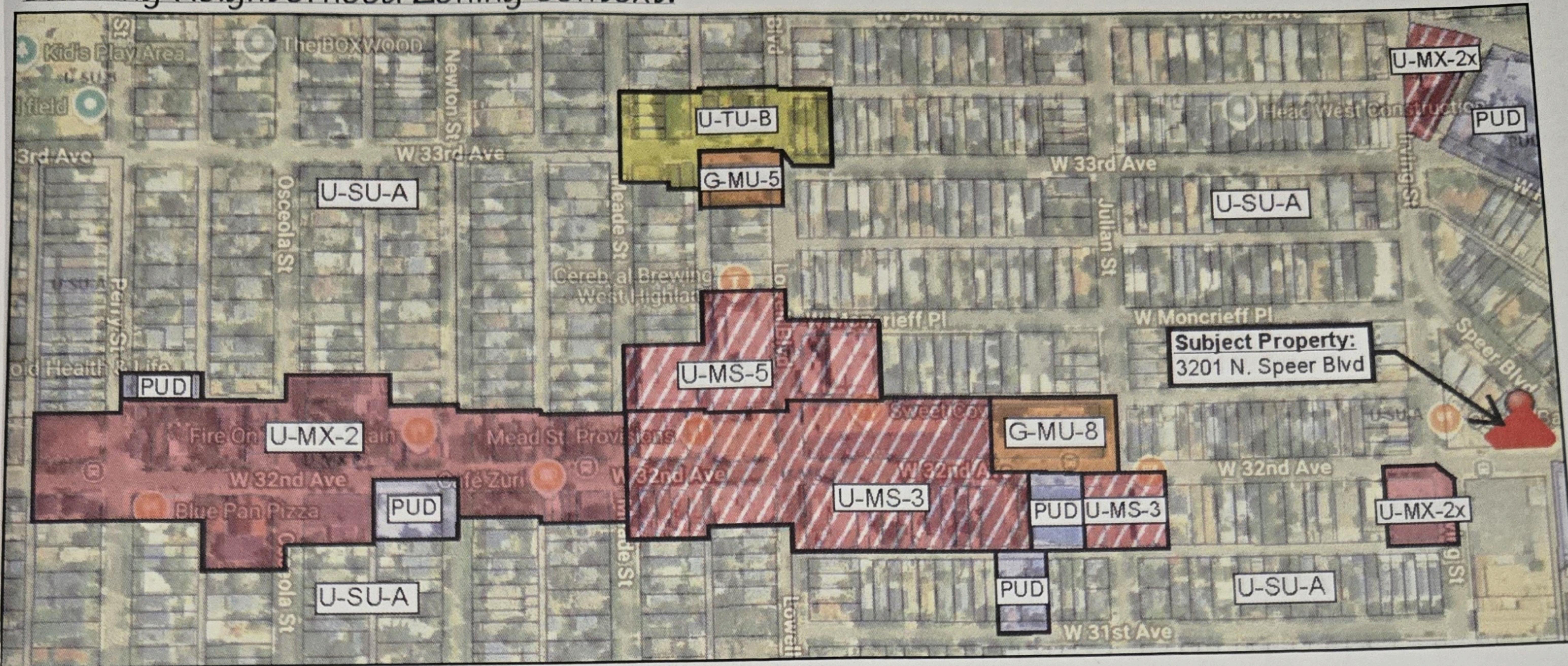
The Denver Planning Board voted 10-0 on July 15 to recommend rezoning 3201 N. Speer Boulevard, advancing the application to City Council without changing the property’s zoning.
The city’s staff report records the unanimous recommendation and says Community Planning and Development staff found the request met Denver’s review criteria. The recommendation does not bind City Council, authorize construction or establish that the property will be redeveloped.
Case 2026-REZONE-0000025 would change the 5,570-square-foot triangular corner lot at West 32nd Avenue and Speer Boulevard from Urban Single Unit A (U-SU-A) to Urban Mixed Use 2 Stories X (U-MX-2X). Some neighborhood materials use “U-MX-2,” but city case materials, the bill request and agendas identify U-MX-2X as the formal proposal.
The proposed district would allow a broader range of potential uses, including retail, office, personal or business services, and eating and drinking uses, while retaining residential capacity. It permits townhouse, general and shopfront building forms, with a maximum height of two stories or 30 feet, according to the city’s zoning code use tables. Those permissions do not represent a planned tenant or approved development.
The property contains a two-story building constructed in 1953. The applicant has told city officials the building would remain and be used more fully for commercial purposes, including possible use of its second floor. The record identifies no tenant, demolition plan, expansion, construction schedule or detailed redevelopment proposal.
Two written comments opposed the broader, permanent development rights that would accompany the rezoning. An adjacent property owner cited potential effects on traffic, parking, neighborhood character and compatibility with nearby homes. Another resident raised concerns about future commercial activity, construction, street-parking demand and changes to the scale of the surrounding residential area. Both said their concerns involved possible future owners and redevelopment, not the existing business.
The West Highlands Neighborhood Association’s land-use committee supported the request, citing the existing building’s retention and continued commercial use. Those are the applicant’s stated intentions, not restrictions on all future development allowed by the zoning.
Planning staff said the request was consistent with Denver’s Comprehensive Plan 2040 and Blueprint Denver, including policies supporting neighborhood-serving businesses, mixed-use centers and corridors, and lower-scale development in an Urban Neighborhood context. Staff also said the rezoning does not assess traffic impacts from a specific future project because none has been proposed.
Wastewater officials did not object to the rezoning itself but said future development would require assurance of sufficient sanitary-sewer and stormwater capacity. The staff report says later site studies could require major improvements funded by a developer or limit development if capacity is inadequate. The rezoning record does not establish that infrastructure capacity is available.
Denver’s Aug. 11 Mayor-Council agenda listed Bill 26-1111 as an action item. It does not report a vote or other council action, leaving the bill’s status unverified in the available record.
The staff report lists Sept. 14, 2026, as a tentative date for a full-Council public hearing and Aug. 24 as a tentative posting and notice date. Both dates remain subject to scheduling; a scheduled hearing would not be a final rezoning decision.