
Denver Planning Board approves rezoning near Paco Sanchez Park; no project is proposed
The proposed change to G-MU-5 could allow apartment buildings generally up to five stories and 65 feet, but sewer capacity, affordability and displacement questions would be addressed only if a future project is proposed.
Published at
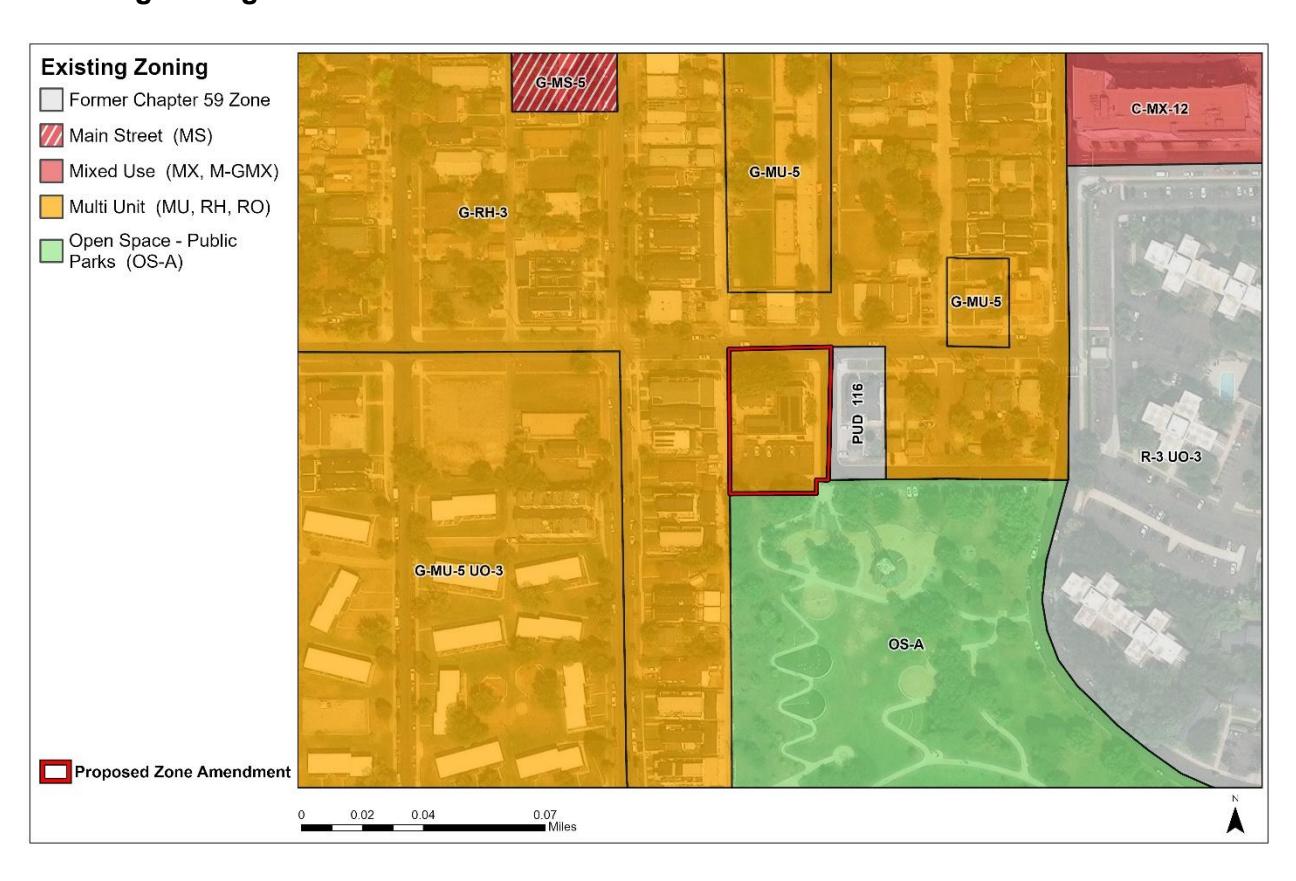
Denver’s Planning Board unanimously approved a rezoning near Paco Sanchez Park that could allow apartment buildings generally up to five stories and 65 feet. But the property owner has not submitted a redevelopment plan or specified how many homes might be built.
The 0.49-acre property at 3418 W. 14th Avenue and 1371 N. Julian Street is owned by the Holy Spirit Association for the Unification of World Christianity. It contains a church and a single-unit dwelling used as a young adult center. The owner is seeking a change from G-RH-3 to G-MU-5, which permits a broader range of residential forms, including townhouses, garden courts and apartment buildings. Denver Community Planning and Development’s staff report says apartment buildings could reach five stories and 65 feet, subject to the zoning code.
The rezoning would not approve construction. The application does not propose a building, unit count or site layout. The church says it is outgrowing its current building and may eventually relocate. It says it is not currently planning to sell, but higher-density zoning could make the property more usable for a future church or more attractive to a future buyer, potentially including a developer.
What is scheduled
The City Council’s Community Planning and Housing Committee is scheduled to consider the rezoning Aug. 18. The committee agenda lists it as an action item.
A City Council public hearing is tentatively scheduled for Sept. 28. As of Aug. 14, the committee had not acted and the proposal had not received final City Council approval. The Planning Board hearing took place Aug. 5, according to city records.
Sewer and park drainage
Denver wastewater reviewers did not object to the rezoning, but they have not found the existing sewer system adequate for future construction. Future development would require assurance of sufficient sanitary- and storm-sewer capacity. Drainage would have to flow east rather than directly south toward Paco Sanchez Park.
The city may require sanitary and drainage studies. Depending on their results, a developer could have to make major infrastructure improvements, or development could be limited if existing infrastructure is insufficient, the staff report says. The report does not provide measured sewer capacity, identify a current deficiency or say that the park currently receives drainage from the site. Those questions would be addressed through later site-plan and development review.
West Area Plan and affordability
City staff concluded the rezoning is consistent with Denver’s Comprehensive Plan 2040, Blueprint Denver and the 2023 West Area Plan. Those plans call for more housing diversity, additional housing near transit and compatible redevelopment of institutional sites. The property is near the West Colfax corridor, bus routes and the W Line’s Knox Station, and sits beside the park.
But displacement and affordability remain unresolved. The West Area Plan implementation memo says some applicant-driven rezonings from single-unit districts to higher-intensity districts may not be consistent with adopted plans until stabilization programs, tools and regulatory changes are in place. It cites redevelopment pressure and the lack of concurrent affordability and stabilization strategies for existing residents.
The memo also says a rezoning can be consistent when programs and commitments ensure affordability as part of new missing-middle housing. The application’s correspondence says Councilmember Jamie Torres told the applicant in 2025 that the West Area Plan guidance still applied to the property. But the record does not establish whether the memo’s “single-unit district” language applies to this G-RH-3 parcel. The application contains no binding affordability covenant, anti-displacement obligation or tenant-relocation requirement.
The application relays planning guidance that a future project with two to nine units might need an affordable-housing element to be considered consistent with adopted plans. A project with 10 or more units would be subject to Denver’s Expanding Housing Affordability requirements. Under the city’s EHA guidance, projects with at least 10 residential units must provide affordable housing on site or use an allowed alternative such as a fee-in-lieu. The city also describes linkage fees for residential developments of nine or fewer units.
Those requirements would apply to a future development, not automatically to the rezoning. The records do not establish a future unit count, affordability mix, tenant impact or whether the property will be sold.
As of the staff-report date, city records reported no comments from registered neighborhood organizations or the general public. That could change as the proposal moves through the committee and City Council process.