
Arvada council signals support for 18-month pause on new data centers
Council members appeared to direct staff to draft a moratorium on qualifying primary-use data centers, but no ordinance, definitions, thresholds or hearing schedule has been adopted.
Published at
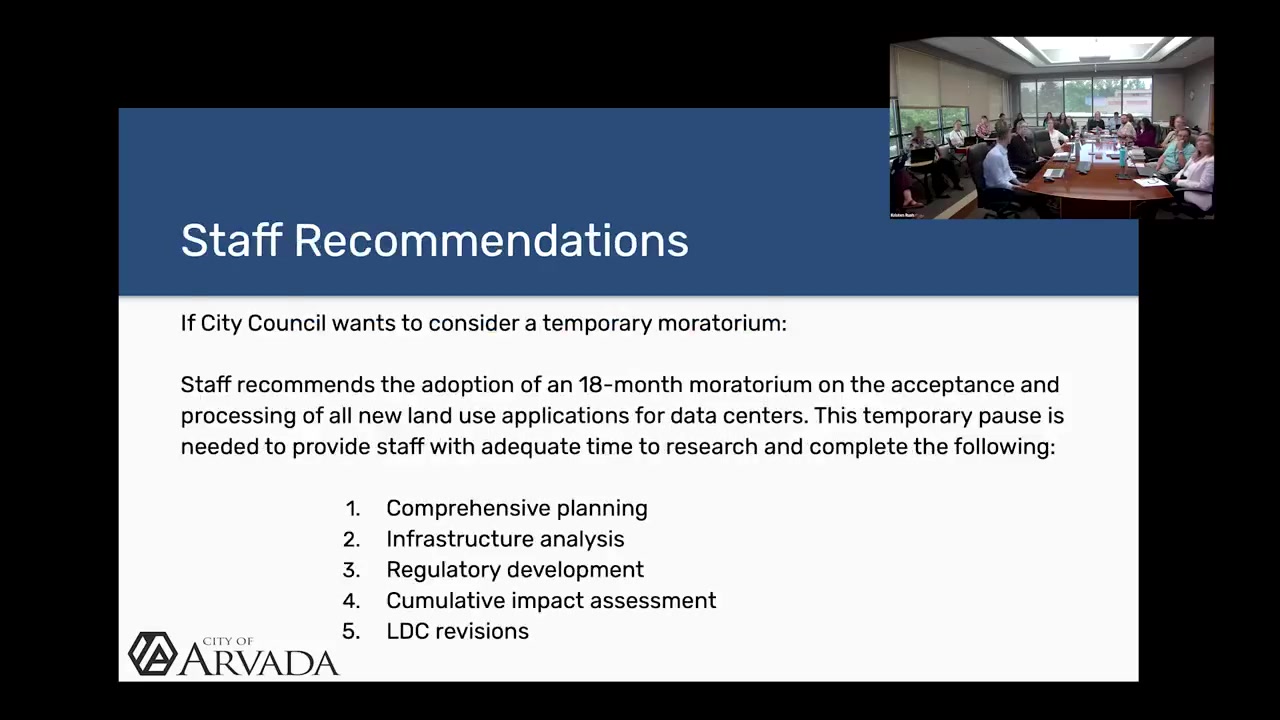
Arvada City Council members appeared to direct staff Tuesday to draft an 18-month moratorium on qualifying proposals for new facilities whose primary use is data-center operations. The council took no formal action, and the proposed pause is not city policy.
The discussion occurred during the council’s Aug. 11 study session, where staff recommended an 18-month moratorium to give the city time to study data-center impacts and revise its land-development code. Members supported distinguishing primary data-center uses from ancillary or smaller computing facilities.
No ordinance was introduced or approved, and there was no formal vote or public hearing. Arvada’s meeting guidance says official decisions are made at business meetings through ordinances, resolutions or motions; study sessions do not make official decisions. The city has not identified a date for draft ordinance language, a public hearing or a final vote in the meeting and legal-notice pages reviewed for this story.
The proposed 18-month period would overlap with the city’s comprehensive-plan process, which staff said could run through about October 2027. Staff said the city would need time to draft land-development-code changes, bring them to the council and seek community input before the moratorium ended.
The scope remains unsettled. No definition of primary or ancillary use, facility-size or megawatt threshold, water-use limit or energy standard was adopted. Council members discussed thresholds ranging from 25 to 150 megawatts and the possibility of regulating aggregate megawatts in the future, but those remain options rather than rules.
Members and staff also discussed possible exclusions for cell towers, internet-service-provider facilities, hospitals, universities, government facilities and small internal data centers supporting a larger business or institution. Any final exemptions would depend on a future ordinance.
Staff said Arvada had no current data-center applications at the time of the study session. The existing land-use code allows data centers in multiple commercial and industrial zoning districts, with conditional approval in some areas and administrative approval in industrial zones. The code includes a 300-foot separation from residential zoning and municipal noise rules, but staff said it has no data-center-specific standards for water use, electricity demand or facility size.
Water availability, electricity demand and grid capacity were central concerns. Members and staff discussed limits based on floor area or maximum daily consumption, closed-loop cooling, discharge requirements, who would pay for grid expansions and whether large facilities could require new generation. They also discussed noise from cooling equipment, fans and backup generators; fire protection; and possible greenhouse-gas or renewable-energy requirements. None was adopted.
Quantum Commons’ treatment remains unresolved
The proposed Quantum Commons development adds a separate question to the planning process. Colorado School of Mines describes Quantum Commons as a 70-acre Arvada campus for quantum research, fabrication and commercialization, with open-access laboratories and room for future expansion. That description does not identify it as a conventional hyperscale data center.
Council members asked whether a future computing operation at Quantum Commons could fall under a moratorium. Staff said the city lacked definitive information about the project’s plans and that the annexation and planning process would provide time to evaluate them. Participants differed over whether quantum-computing operations could require data-center-scale infrastructure.
Because no ordinance was approved, the session did not determine whether Quantum Commons would be covered, exempt or subject to separate conditions. Arvada’s annexation process calls for applications to be reviewed by city staff and considered at public hearings before the Planning Commission and City Council. The project’s final plans, along with any future moratorium definitions and exclusions, will determine how the issues intersect.