
Denver pauses data-center applications as officials draft new rules
A moratorium runs through May 21, 2027, while Denver develops zoning, energy, utility-cost and community-impact standards for data centers.
Published at
Denver has paused acceptance and processing of applications for data centers proposed as a primary use while officials develop new rules for facilities that can consume large amounts of electricity and water and affect surrounding neighborhoods.
The City Council approved the moratorium in Bill 26-0431 on May 18, 2026. The council president signed it that day, and Mayor Mike Johnston signed it May 20. The moratorium runs through May 21, 2027.
A city presentation prepared for an Aug. 18 Community Planning and Housing Committee briefing describes the vote as unanimous. It also says the pause applies to new data-center development and construction, while operations permitted before May 21, 2026, are not affected. The bill's language applies to applications in which a data center would be the proposed primary use.
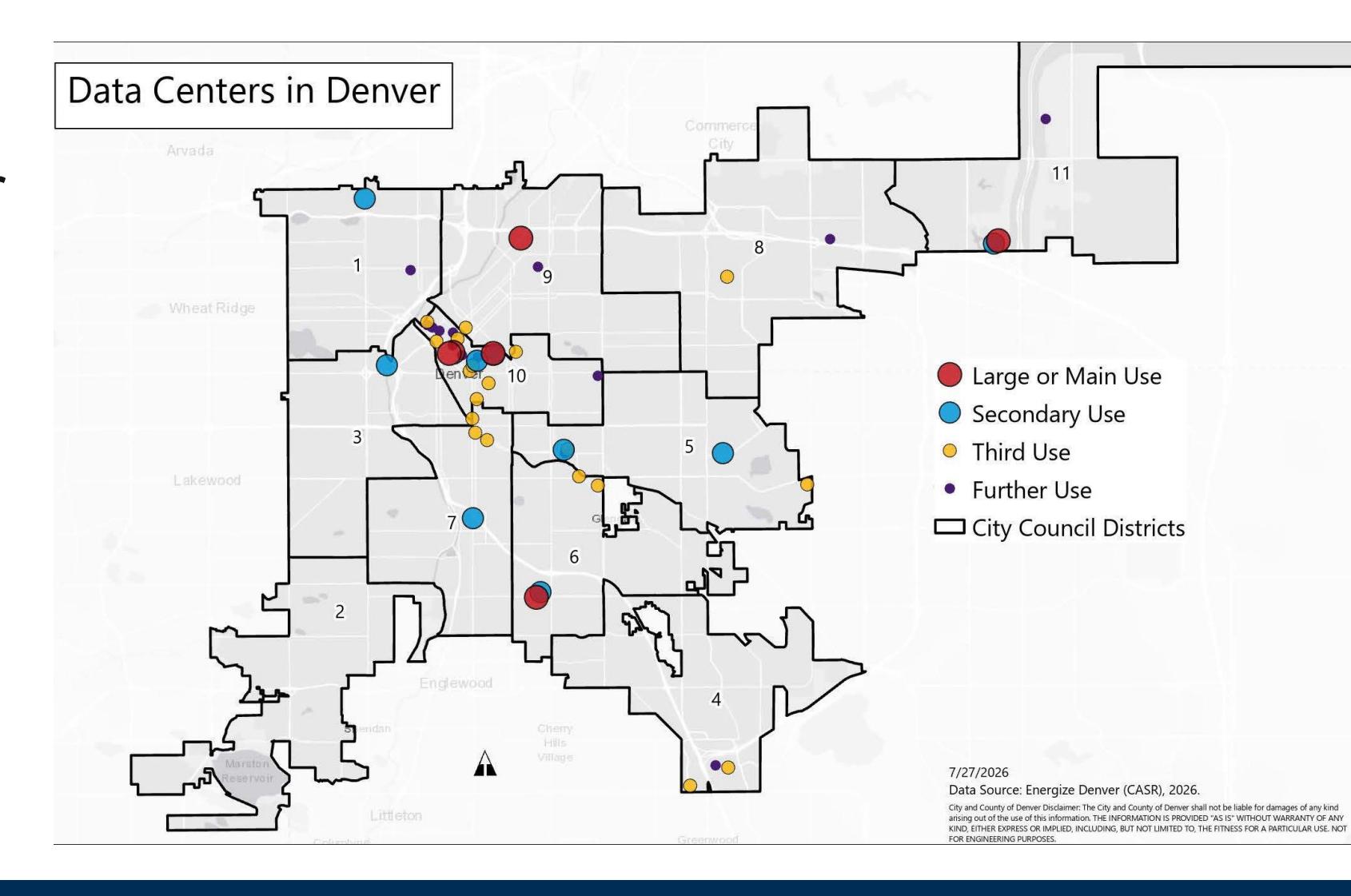
That leaves Denver's existing facilities and at least one project already under construction apparently outside the moratorium's scope. The city presentation says Denver has about 50 data centers, ranging from roughly 200 to 200,000 square feet. Five buildings are used entirely as data centers; others house data-center operations as a secondary use.
CoreSite's DE1 at 910 15th St. and DE2 at 639 E. 18th Ave. are listed as operating facilities. CoreSite's DE3, a roughly 170,000-square-foot, 18-megawatt facility at 4900 Race St. in Elyria-Swansea, was under construction before the moratorium's May 21 cutoff. CoreSite says DE3 was scheduled to begin operations in June 2026.
CoreSite's broader Elyria-Swansea campus plan also includes two additional facilities that had not been approved by Denver as of February 2026. Denverite reported that the unapproved facilities were part of a planned 600,000-square-foot campus. Available records do not name those facilities or establish whether the moratorium affects them.
The pause is intended to give Denver time to address what the presentation calls a gap in the city's land-use rules. Officials are considering changes to zoning and municipal codes, building and energy standards, and other policies. The working group's scope is expected to include public health, neighborhood and community impacts, climate goals, utility costs, technology needs and future development, with particular attention to vulnerable and adversely affected communities.
The materials refer to shared natural resources and “fair utility costs,” but do not specify how water use, energy consumption or utility-cost allocation would be measured or regulated. They also do not set a specific energy threshold, water-use standard, number of working-group seats or representation criteria for vulnerable and adversely affected communities.
Group 14 Engineering and Civic Consulting Collaborative were selected to co-facilitate the work. Group 14 will provide technical analysis and policy support, while Civic Consulting Collaborative will lead stakeholder engagement and the public process.
The proposed working group would include council members, utilities, unions, industry representatives, advocates, community members and subject-matter experts, with city staff in a supporting role. Planned participation options include virtual and in-person meetings, online forms, email, interpretation and language-access services, and public comment on draft recommendations.
The city's prospective schedule calls for:
- Aug. 21, 2026: Launching an open application process for working-group members.
- By the end of August: Launching Denvergov.org/Datacenters and opening public-feedback channels.
- By the end of October: Announcing working-group members, holding an initial public meeting and expanding participation resources.
- October through December 2026: Holding working-group meetings, neighborhood meetings and additional outreach.
- January through April 2027: Publishing draft policy recommendations for public feedback.
- May 2027: Proposing final recommendations.
- Summer 2027: City Council review, discussion and votes on a policy package.
The presentation does not give exact dates for most steps, an application deadline, the number of working-group seats or selection criteria. Its timeline describes planned activities, not events that had already occurred. As of Aug. 17, the proposed Denvergov.org/Datacenters page returned a city 404 page, and no application form, public-comment email or meeting calendar could be independently verified.
The Community Planning and Housing Committee agenda scheduled a 1:30 p.m. Aug. 18 briefing on the moratorium. The agenda establishes that the briefing was planned, not what occurred. Council members Serena Gonzales-Gutierrez, Paul Kashmann and Darrell Watson said they would seek an extension if more time is needed to complete the policy work before the moratorium expires.