
Englewood, Littleton councils to review South Platte Renew authority plan
The councils are scheduled to consider a possible new utility authority, a proposed $41.3 million 2027 budget and a $106.5 million five-year capital plan at an Aug. 27 study session.
Published at
Englewood and Littleton city councils are scheduled to review a possible new authority for the jointly owned South Platte Renew wastewater utility on Aug. 27, along with a proposed 2027 budget of $41,319,321 and a five-year capital plan totaling $106.545 million.
The agenda and presentation packet schedules the joint study session for 7:30 a.m. at South Platte Renew, 2900 S. Platte River Drive in Englewood. The governance discussion is scheduled for 9:25 a.m., followed by questions and answers. The session is not a formal action meeting.
Because the meeting is still in the future as of Aug. 22, the packet describes what staff plans to present, not what the councils will discuss or decide. No post-meeting minutes, transcript, recording or other official action record was available for review.
The proposed 2027 budget would increase by $330,756, or 0.8%, from the 2026 budget. Proposed capital expenses total $17,002,100, down $770,000 from the prior year, while personnel, commodities and contractual services would increase.
The proposed 2027-31 capital improvement plan totals $106.545 million. Its largest proposed 2027 project is a $10.575 million sidestream PNA project, categorized as a regulatory-compliance investment. The packet does not provide a construction schedule, a fuller project description or a quantified environmental outcome.
Under the possible structure described in the packet, Englewood and Littleton could create a separate public corporation to operate South Platte Renew. The utility’s assets and 88 employees would transfer to the authority, which would manage its finances, operations and capital program. The authority could add employees as needed.
The cities would retain their collection systems, contracts with connector sanitation districts and customer billing. South Platte Renew would issue wholesale bills to the cities, which would remain responsible for billing customers and maintaining relationships with connector districts. The packet recommends preserving a 50/50 ownership structure for the authority’s board but does not specify the number of seats, appointment terms, tie-breaking procedures or the role of connector districts.
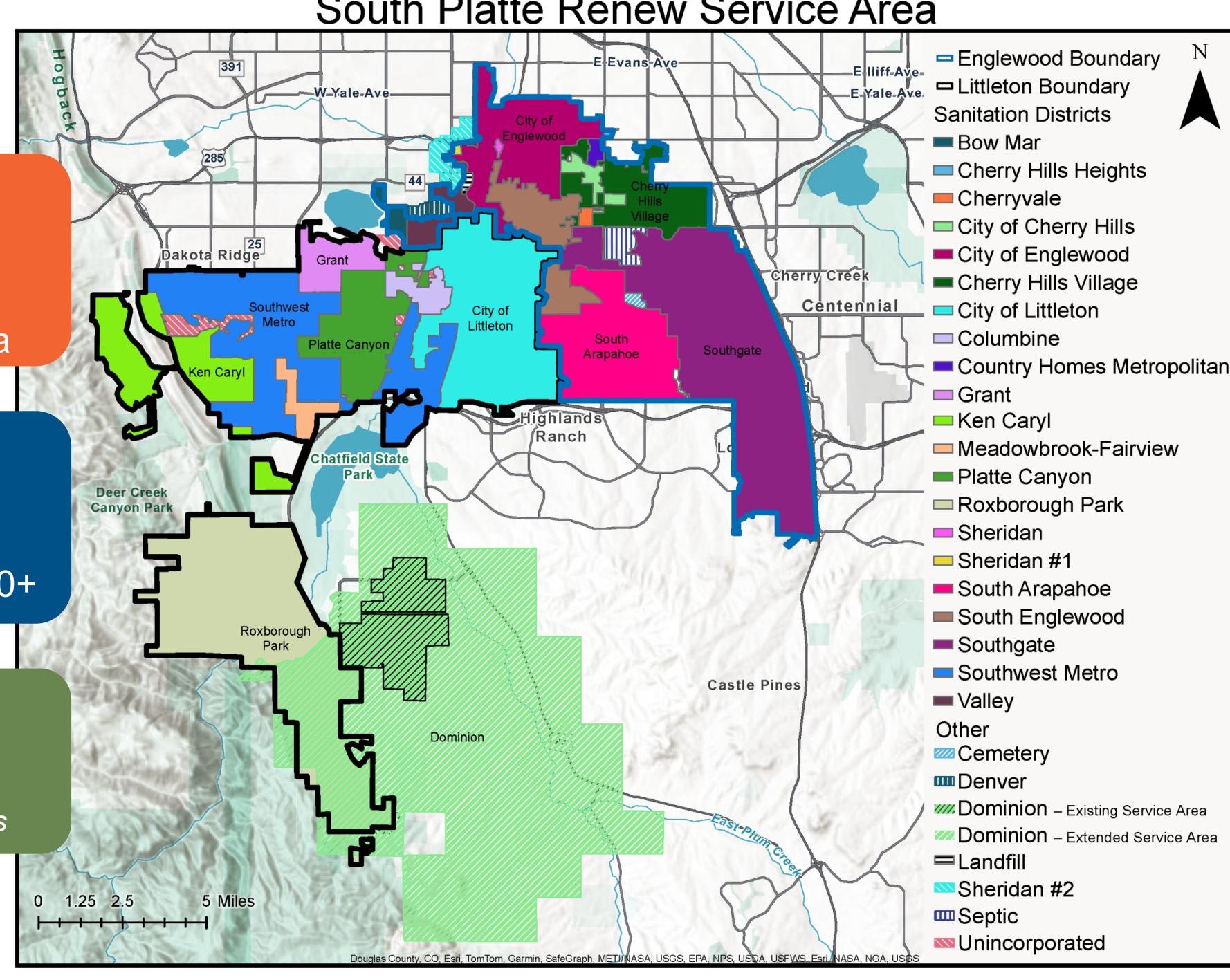
South Platte Renew serves more than 300,000 customers across a 113-square-mile service area, according to the packet. More than 220,000 are served through connector districts, compared with more than 35,000 Englewood customers and more than 45,000 Littleton customers.
The packet identifies possible benefits of an authority, including more predictable costs and rates, centralized administration, debt and rate smoothing, utility-specific financing and potentially lower interest costs. It references possible rate savings of about 0.5%, but does not provide customer-by-customer rate estimates, an administrative-savings calculation or a total borrowing-cost reduction. It also does not state the amount, maturity or refinancing schedule of South Platte Renew debt; an existing federal WIFIA loan held by Englewood is listed as an issue for further analysis.
The proposed structure would shift operational liability to the authority, according to the packet, while some legacy liability would remain with the cities. The materials do not quantify those liabilities or explain how each existing obligation would be allocated.
The study-session packet does not include a formal authority proposal, draft formation agreement, implementation schedule or decision date. It also does not authorize creation of an authority or approve the proposed budget or capital plan. Any later proposal would require additional action by both cities.