
Denver committee advances HOST’s 2027 housing plan amid calls for stronger accountability
The one-year continuation plan sets 13 housing and homelessness goals, but leaves target-specific funding, executed-eviction figures and family-homelessness measures unresolved.
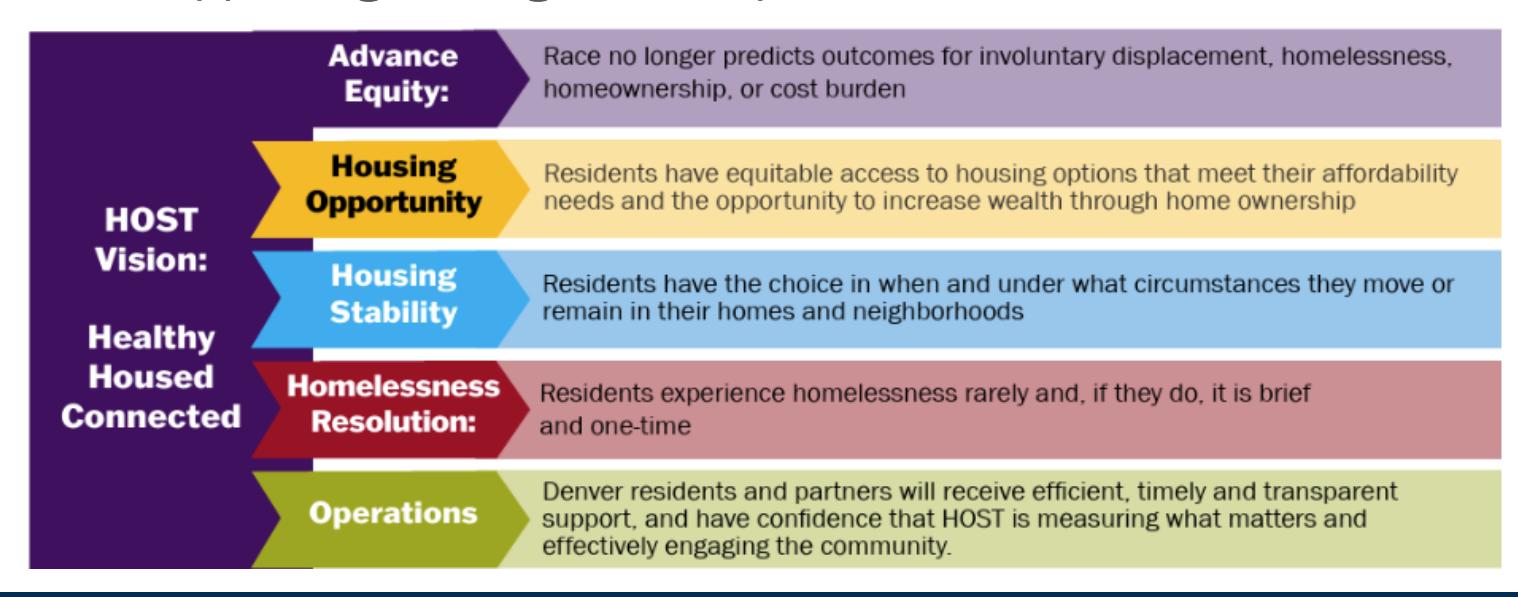
Denver City Council’s Community Planning and Housing Committee advanced a one-year continuation plan for the Department of Housing Stability on Tuesday, Sept. 1, while members pressed the department for more detailed eviction, funding, racial-equity and family-homelessness data.
The committee approved items 25-1253 and 25-1254 as a block for consideration by the full City Council. The measures would authorize HOST’s 2027 continuation plan and related municipal-code changes while the city completes a Housing Needs Assessment and develops a new long-range housing and homelessness strategy.
The committee action was not final council adoption. HOST said the Housing Needs Assessment is expected by December 2026. The next long-range plan is due to the council by Sept. 1, 2027, with implementation planned for January 2028.
The Sept. 1 committee video records the vote and discussion.
The 2027 goals
HOST’s continuation plan sets 13 goals across housing opportunity, housing stability and homelessness resolution. It does not assign a dollar amount or dedicated funding source to any individual target. Stakeholder materials say prevention and rental assistance are severely underfunded, resource constraints limit investment and no significant new funding streams are available.
The HOST strategic-plan presentation lists these goals:
Housing opportunity
- Develop at least 930 housing units.
- Preserve at least 490 apartments in income-restricted rental properties and ownership homes.
- Explore ways to produce 3,000 deed-restricted units in market-rate developments by the end of 2028 and each following year. The plan treats this as an exploration and future-production goal, not a separate 2027 target.
- Reduce the housing-cost-burden rate among low- and moderate-income households from 59% in 2021 to 51%.
- Increase homeownership among low- and moderate-income households from 36% in 2021 to 41%, and among BIPOC households across income levels from 41% to 45%. The plan does not set separate targets for Black, Latino or other groups.
- Use the Housing Needs Assessment to identify needs for people with disabilities and develop measures to address gaps in accessible-unit supply.
Housing stability
- Prevent at least 700 households from becoming homeless through rapid resolution and eviction prevention. HOST said rapid-resolution results will be tracked in Submittable and eviction prevention in the Homelessness Management Information System, or HMIS.
- Monitor the prioritization policy intended to give residents at risk of displacement, or already displaced, priority access to new affordable housing.
Homelessness resolution
- Reduce overall homelessness by 30% in 2027 compared with 2024 and maintain an unsheltered Point-in-Time count of 350 people.
- Provide shelter to at least 12,000 unique households in 2027.
- Provide 2,000 households experiencing homelessness with permanent or stable housing.
- Serve 3,200 households through rehousing and supportive-housing programs.
- Continue toward functional zero for veteran homelessness by placing at least as many veterans into permanent housing each month as the number experiencing homelessness.
The plan does not consistently provide baselines, reporting schedules, measurement systems or target-specific funding for these goals. It also does not assign potential funding sources — including bonds, credit enhancements, community-ownership vehicles or public dollars — to particular targets.
Mixed results under the 2022–2026 plan
HOST reported that income-restricted housing reached 8.1% of Denver’s housing stock, above the previous 7% goal, and that 1,424 affordable apartments were preserved during the plan period.
The department reported 865 permanent supportive-housing units, short of the previous 900-unit benchmark, and said it did not meet its broader affordable-housing creation target. The committee record does not provide the exact number of homes created or the complete underlying calculation.
Housing cost burden increased rather than declining from the 2021 baseline of 59%. Low- and moderate-income homeownership did not reach its 41% target, and BIPOC homeownership did not reach 45%, although HOST said the BIPOC rate moved in the intended direction. A goal of reducing foreclosure filings for income-restricted units from 10 to zero also moved in the wrong direction.
HOST reported that unsheltered homelessness declined 64% from 2023, while overall homelessness declined 12.5% from 2025 to 2026. Sheltered and unsheltered homelessness among newly homeless and chronically homeless people declined by about 30%. The figures are not directly interchangeable with measures that used a 2021 baseline.
Denver also reported ending the cycle of veteran street homelessness in 2024. HOST officials cautioned that this did not amount to functional zero for all veteran homelessness: Just under 60 veterans remained on the current by-name list, they said, and there had been some backsliding.
HOST said it served 2,374 households annually through rapid rehousing and supportive housing, below the previous goal of 3,000. The average length of homelessness fell from 357 days to 243 days but remained above the prior 90-day goal. Officials said family exits from shelter and outreach to housing improved, but the records do not provide the final percentage.
Eviction filings are not executed evictions
The previous plan sought to reduce annual eviction filings from 8,800 to 6,600. HOST officials told the committee that filings later rose and stabilized at roughly 16,000 a year, with one speaker citing about 15,000 filings in the prior year.
Officials and council members emphasized that a filing is not the same as an executed eviction. A state-law change altered the timing of filings, and HOST said its executed-eviction data is lower than the filing total. The committee record does not provide the actual executed-eviction count.
Councilmember Jamie Torres said filings are not an adequate stand-alone measure. She said eviction-defense partners supported about 3,500 cases and that one-third were dismissed with their help, and asked HOST to compare those results with 2021 or 2023. HOST did not provide that comparison during the meeting.
Councilmember Shontel Lewis asked where people go after an executed eviction and how the city tracks whether they become homeless. HOST Executive Director Cole Chandler said an eviction does not necessarily lead to homelessness or cause someone to appear in a one-night Point-in-Time count.
Anti-displacement, racial equity and families
The continuation plan addresses anti-displacement through HOST’s prioritization policy but sets no numeric anti-displacement outcome. HOST staff said the Housing Needs Assessment contract includes an anti-displacement and reinvestment strategy being developed with Community Planning and Development and the Denver Economic Development & Opportunity office. No final strategy was available in the records reviewed.
The plan’s primary racial-equity measure is the goal of increasing BIPOC homeownership from 41% to 45%. Council members said the aggregate BIPOC category can obscure differences among racial and ethnic groups, particularly the gap in Black homeownership, and asked for more specific targets. The plan does not identify a separate racial-equity funding allocation.
Families with children do not have a distinct 2027 target. The previous plan sought to increase the share of family households exiting shelter and outreach programs to housing from 25% to 50%, but HOST’s continuation plan does not include a replacement family-specific measure.
Lewis asked HOST to distinguish children under 18 in homelessness reporting, including young children who may not appear in school-system data. Council President Diana Romero Campbell said the discussion of “households” did not adequately identify families with children. Chandler acknowledged that family homelessness had grown as more than 40,000 newcomers arrived in Denver and said it should be a priority in the 2027 budget and an explicit part of the next long-range plan.
Committee members also asked HOST to connect funding streams to results and calculate return on investment. Chandler said the department would provide more transparency about allocations among housing opportunity, housing stability and homelessness resolution, but said program-level return on investment is difficult to calculate because HOST operates overlapping programs.
The plan now goes to the full City Council. Unresolved questions include the amount of 2027 funding, the number of executed evictions, target-specific outcomes and funding, the final Housing Needs Assessment, and whether the next long-range plan will add explicit measures for anti-displacement, families with children and racial disparities.