
Arvada council gives preliminary direction on sex-offender housing buffers
The proposed rules would limit where people required to register as sex offenders could establish new residences, with separate buffers for sexually violent predators.
Published at
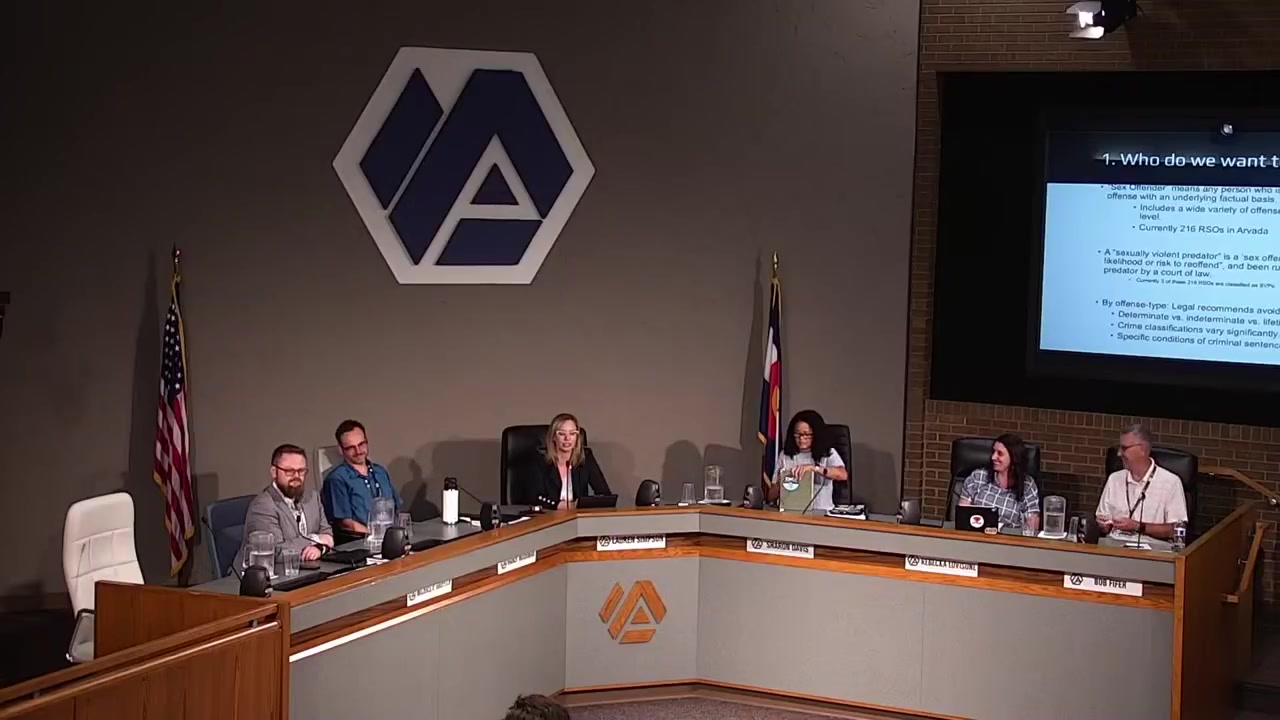
The Arvada City Council directed city attorneys Sept. 8 to draft an ordinance restricting where people required to register as sex offenders could establish new residences. The preliminary direction calls for a 500-foot buffer, with a 1,000-foot buffer for people classified as sexually violent predators.
The recorded workshop shows that the council asked the city attorney’s office to continue drafting. No ordinance, final map, list of restricted locations or effective date was adopted.
The proposal would regulate establishing a residence — buying or renting a home or apartment — rather than visiting a location. It would not prohibit otherwise permitted activities such as attending a school event, visiting a park or traveling through a restricted area, subject to court, probation, parole or state requirements.
What the proposal would cover
The preliminary direction would use a 500-foot buffer for people required to register as sex offenders, excluding parks and trails from the restricted locations. The 1,000-foot buffer for sexually violent predators would include parks and trails.
Schools, child-care facilities, libraries and open-space areas were among the other locations discussed. The final draft would need to specify which locations are included and how distances are measured. The city attorney said maps showed that a buffer larger than 1,000 feet could make it practically impossible to establish a residence in Arvada.
The city attorney also said the city could not impose a blanket ban, apply the restrictions retroactively to existing residences or regulate juveniles. A person already living in Arvada would not be required to leave solely because of a future ordinance. A July 1, 2027, effective date was discussed as a hypothetical example, not adopted action.
The proposal would not apply outside Arvada’s city limits. Adjacent unincorporated Jefferson County areas would remain under county jurisdiction unless the county adopted its own rules.
Public-safety and housing questions
The workshop did not establish that residential buffers reduce sexual reoffending. Research reviewed by the National Institute of Justice found, at most, a marginal effect in the studies it discussed. In one Minnesota analysis, none of 224 examined sex offenses appeared likely to have been prevented by a residency restriction.
A 2014 review by the Washington State Sex Offender Policy Board likewise reported no research evidence that residency restrictions deter future crimes. It cited concerns that such rules can reduce access to stable housing, family support, employment, treatment and supervision while contributing to homelessness or transience.
The review also described research suggesting that restrictions can concentrate registrants in fewer unrestricted areas or just outside restricted jurisdictions. A separate National Institute of Justice summary found that the size and scope of hypothetical buffers affected the amount and affordability of available housing. Those studies do not predict the effect of Arvada’s proposal.
The Colorado Supreme Court has held that Colorado municipalities may regulate sex-offender residency under local ordinances. The court’s 2016 decision in Ryals v. City of Englewood addressed state-local authority and preemption, not whether residential buffers improve public safety.
The city attorney’s office is expected to return with draft language for council consideration. Until the council adopts an ordinance, the proposed buffers, restricted locations and effective date remain unsettled.