
Denver Public Schools enrollment falls 1,740, with high school grades accounting for more than half
The Sept. 17 count put enrollment in district-managed schools 755 below projections; grades 9 through 12 accounted for 909 of the year-over-year decline.
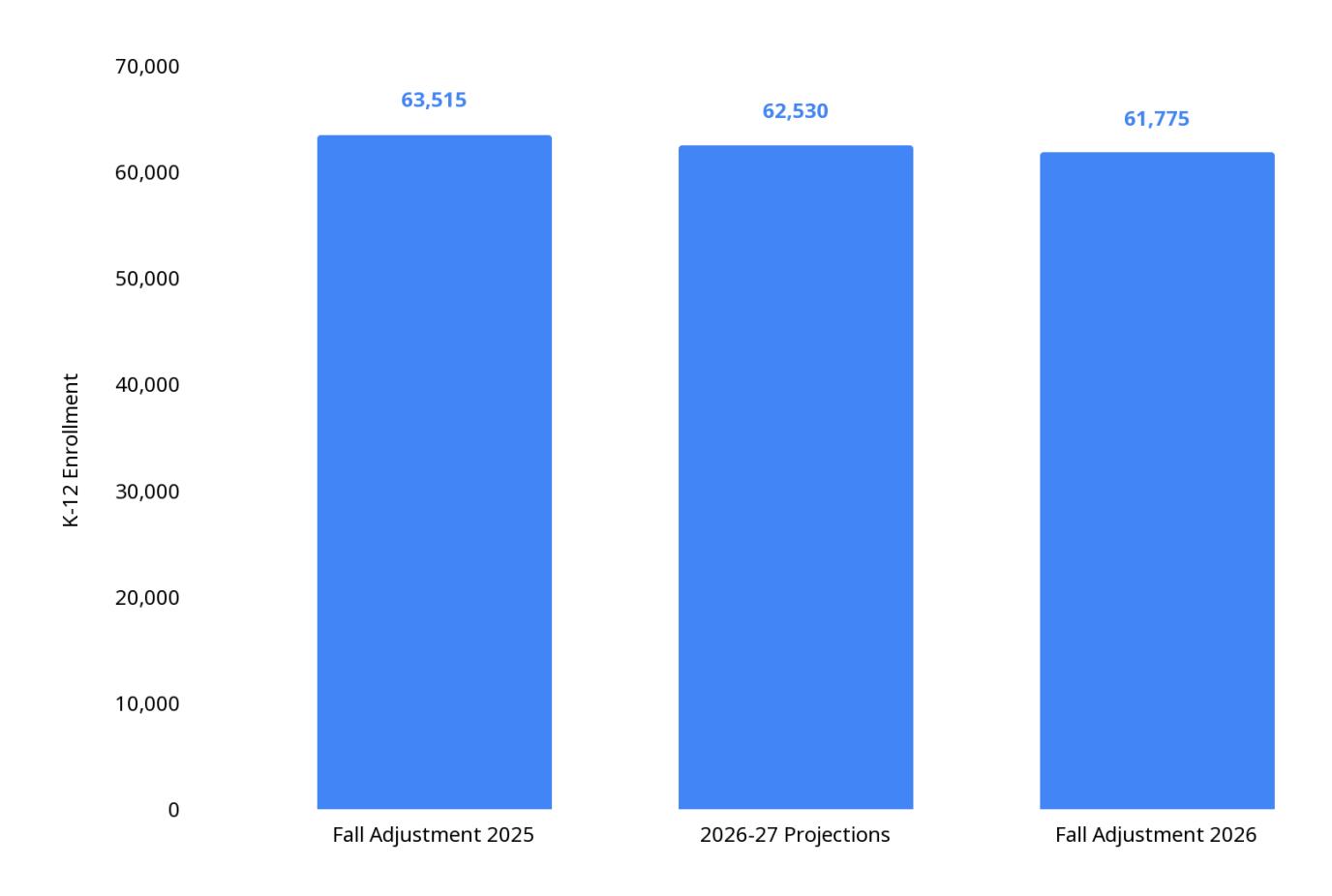
Denver Public Schools counted 61,775 students in district-managed schools on Sept. 17, down 1,740 from a year earlier and 755 below projections, with high school grades accounting for more than half the annual decline, enrollment materials prepared for the Board of Education’s Oct. 5 Finance and Audit Committee meeting show.
Grades 9 through 12 were down 909 students from the prior year, a 4.6% decline. In a separate comparison by school type, high schools had the largest gap against projections: 620 students, or 4.19%, below expected enrollment.
Among district-managed schools at least 20 students below projections, Thomas Jefferson High School had the largest gap at 131 students, followed by John F. Kennedy High School at 126 and Abraham Lincoln High School at 101. In all, 29 schools—just over 21% of district-managed schools—were at least 20 students below projections, with an average gap of 47 students.
A separate snapshot of active enrollment on Sept. 28, compared with the prior October count, showed declines in every region. Southwest Denver had the largest decline, with 820 fewer students.
Enrollment affects school-level planning and funding: under student-based budgeting, the presentation says, schools receive or return the base per-pupil amount for each student above or below projections.
Separately, the Board of Education is scheduled to review draft policy EL18 on Oct. 8. The proposal would require boundary analysis at least every five years starting in the 2026–27 school year, along with annual reporting on enrollment, demographics, school use, and financial and program implications. For possible consolidations or closures, the draft calls for a broad review, community engagement and consideration of equity and transportation impacts; it says consolidation should be considered before closure when viable. The Oct. 8 agenda packet presents EL18 as draft policy for review, not an adopted policy or a decision about specific schools.