
Denver draft would require affordable home for housing bonuses, delay floor-area limits
The proposal would limit housing bonuses to areas near transit, require at least one affordable unit and defer floor-area limits for further study.
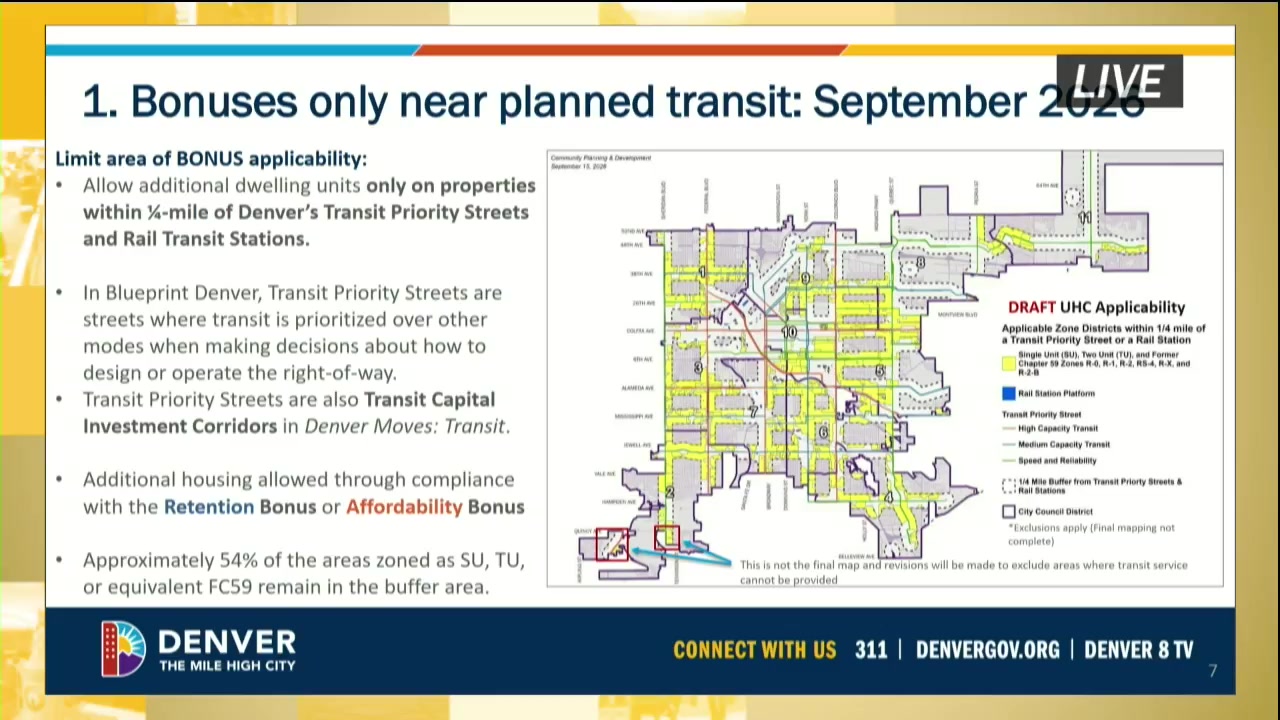
Denver planning staff’s revised draft would require at least one affordable home for properties to qualify for a housing bonus, while deferring proposed floor-area limits for further study.
The affordability bonus would require a unit affordable to households earning no more than 70% of area median income for rentals or 100% for ownership. Staff presented the changes at a Sept. 28 City Council and Planning Board working-group meeting, describing them as project-team recommendations still open to feedback, not adopted policy.
The proposed bonuses would be limited to eligible single- and two-unit zoning districts within a quarter-mile of transit-priority streets or existing and future rail stations. Staff said the draft map would include about 54% of the land area and 58% of the parcels eligible under an earlier citywide approach. The map remains subject to refinement.
Staff proposed postponing floor-area limits until a later phase, saying the narrower pilot area changed the logic of the earlier approach and the limits needed more study and calibration. Feedback on the proposed floor-area allowances was mixed: some participants considered them too large, while others said they could be too restrictive. Staff said it could revisit the limits after monitoring development under the first phase; the design of any later limits has not been settled.
The retention bonus would require preserving an existing primary structure at least five years old and keeping it for at least five more years. The proposal would allow up to two primary units in suburban contexts and up to four in urban and urban-edge contexts.
The transit-area restriction would apply to the bonuses, not all proposed zoning changes. Staff said other first-phase building-form changes, including revisions to house-scale forms, half-story rules and entry features, would still apply citywide. The existing bulk-plane system would also remain in the first phase.
Staff said the project schedule had slipped by about two to three months. The tentative schedule included an Oct. 20 advisory committee discussion and public meetings across Denver from Nov. 4 to 19. Planning Board and City Council hearings would come later; staff said it hoped for a Council hearing around March.