
Denver Fire says it will fix audit issues by July 1 as chief defends suburban service agreements
A Denver audit found weak documentation, cost tracking and oversight for fire-service agreements with Englewood, Glendale, Sheridan and Skyline. At a June 3 council briefing, Fire Chief Desmond Fulton argued the deals remain valuable, but the audit itself did not reach that broader conclusion.
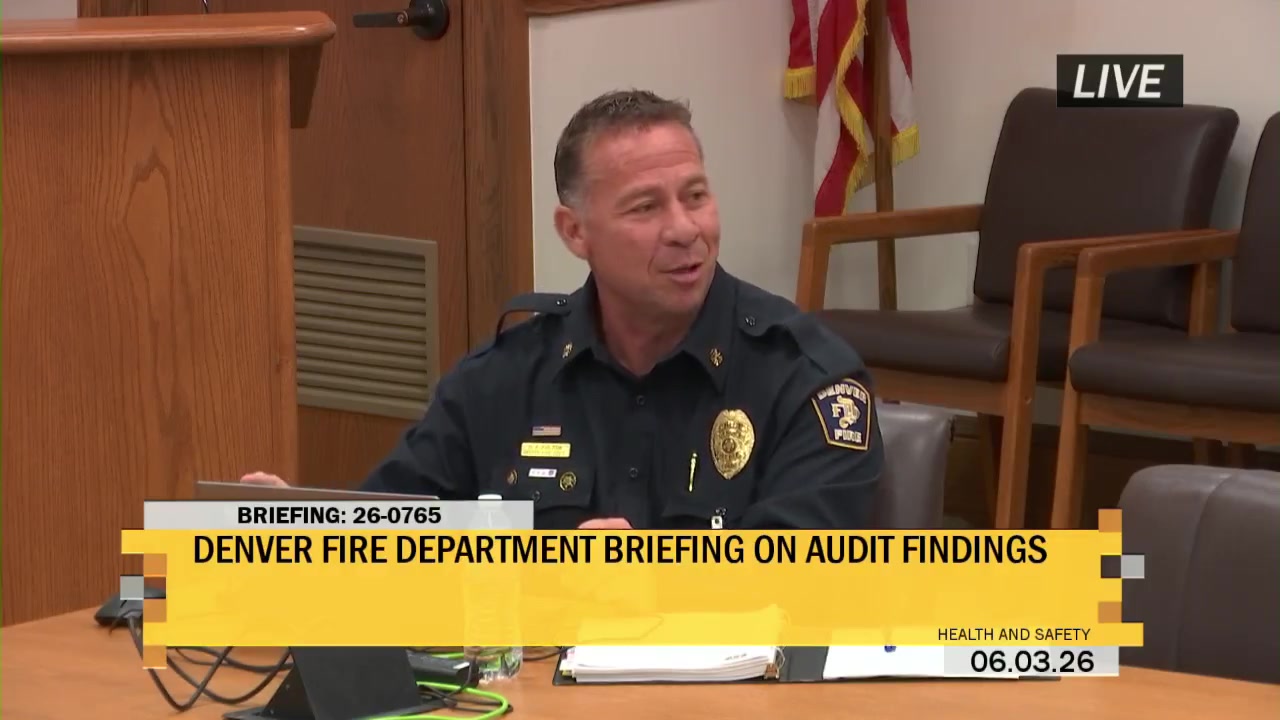
Denver Fire Chief Desmond Fulton told City Council on June 3 that his department expects to complete most corrective actions from a recent audit by July 1, while defending long-running service agreements with Englewood, Glendale, Sheridan and the Skyline Fire Protection District.
The auditor’s April report was narrower than Fulton’s broader public-safety argument for keeping the agreements intact. Auditors found Denver Fire’s administration of the agreements “could be strengthened” because renewals were informal and poorly documented, cost-benefit work was incomplete, payments and expenses were not consistently tracked, and required joint advisory-board processes were not being fully followed. Denver Fire agreed with all 11 recommendations, most with a July 1 implementation date.
At a Health and Safety Committee briefing, Fulton said the department receives about $7.3 million a year from Englewood, $3 million from Glendale, $2.6 million from Sheridan and about $445,000 from Skyline. He said the outside stations also frequently respond into Denver, especially in the south part of the city, and argued that losing those companies would force Denver to accept slower response times or consider building new stations.
The audit supports part of that defense. Auditors wrote that representatives from all four outside jurisdictions reported positive working relationships with Denver Fire and said service levels and response times were outstanding. The report also said earlier Denver Fire cost estimates for renewals looked at direct expenses such as payroll and equipment but did not include potential nonmonetary benefits such as improved service and response times.
But the audit did not conclude the agreements lose money for Denver, and it did not recommend canceling them. It also did not validate Fulton’s June 3 claim that Denver clearly comes out ahead once the value of cross-border response coverage is counted. Instead, auditors said Denver Fire needs a documented process for future cost-benefit analyses, including both quantitative and qualitative benefits, and should periodically reassess long-term agreements rather than relying on informal practice.
Council members who spoke at the briefing largely backed Fulton’s broader argument rather than the audit’s narrower process focus. Councilmember Amanda Sawyer said the Glendale house is “unspeakably important” to nearby Denver neighborhoods because it improves response times, while Council President Amanda Sandoval said some audit recommendations did not appear to account for safety and accreditation concerns. No committee member in the public meeting record argued for reopening the contracts to seek higher payments.
Fulton also warned that reopening the agreements could invite competition from South Metro Fire Rescue, a larger regional agency south of Denver, and said losing one or more of the contracted companies could threaten Denver Fire’s ISO Class 1 standing and affect insurance outcomes. The public record reviewed for this story only partly supports those warnings.
General fire-protection guidance from the Insurance Services Office shows that fire-protection ratings used by insurers are tied to factors including staffing, apparatus, water supply and communications, so Fulton’s basic point that station losses could affect insurance-related ratings is plausible. But neither the audit nor the June 3 committee record includes an independent analysis showing exactly how many stations or companies Denver could lose before its ISO standing, accreditation or insurance outcomes would change.
The same is true of the competition argument. Fulton said some contract clauses could let either side reopen terms and warned that doing so could expose the agreements to outside bidders. But the available public record reviewed for this story does not include the contract language itself, any current solicitation, or any public statement from Englewood, Glendale, Sheridan, Skyline or South Metro indicating that the agreements are about to be rebid.
What is established now is more limited but still significant: the audit found process weaknesses in how Denver Fire manages these agreements, Denver Fire has publicly accepted all of the recommendations, and council members used the first public airing of the dispute to signal skepticism of any push to reopen deals that help cover south Denver.
The committee heard the briefing but took no formal action. The next test will be whether Denver Fire meets its promised July 1 deadline — and whether later cost-benefit work backs up, narrows or undercuts Fulton’s claim that the contracts are indispensable to Denver residents as well as to the neighboring jurisdictions that pay for them.