
Englewood begins drawing on reserve water supply as restrictions, rate increases advance
Officials say Englewood began using its reserve supply in mid-July, as proposed watering limits and 2027 utility-rate increases move toward City Council consideration.
Englewood began drawing on a reserve water supply in mid-July for the first time in records dating to at least 1965, officials told the Water and Sewer Board on Aug. 11. The city is considering mandatory outdoor watering limits and higher utility rates as low snowpack, low South Platte River flows and sustained heat pressure supplies.
Utilities Director Peter Van Ruyen and the board attorney said the reserve-use history is based on city and Denver Water records dating to at least 1965, while noting that earlier use outside those records could not be ruled out. Staff said voluntary conservation had reduced water use by about 5% from 2025 and 10% from 2024, but that further reductions were needed to slow depletion and protect supplies into the fall and next year, according to the Water and Sewer Board meeting recording.
The board forwarded a proposed mandatory watering plan to City Council for consideration rather than recommending outright approval. The plan would allow outdoor watering two days a week: Mondays and Fridays for odd-numbered addresses, and Tuesdays and Saturdays for even-numbered addresses. Watering would be prohibited from 10 a.m. to 6 p.m. The restrictions would apply to Englewood and the city’s extraterritorial water customers.
The proposal would exempt growing produce. Staff said the schedule could reduce demand by an estimated five to eight acre-feet per day. Enforcement would initially focus on education, with utilities field workers and code-compliance staff expected to issue warnings through tags or door hangers. Fines under the existing water-waste code could be considered in the most egregious cases, staff said.
City officials identified Aug. 17 as the next scheduled City Council consideration of the restrictions. The available record does not show a council vote, adoption or effective date, so the limits remain proposed.
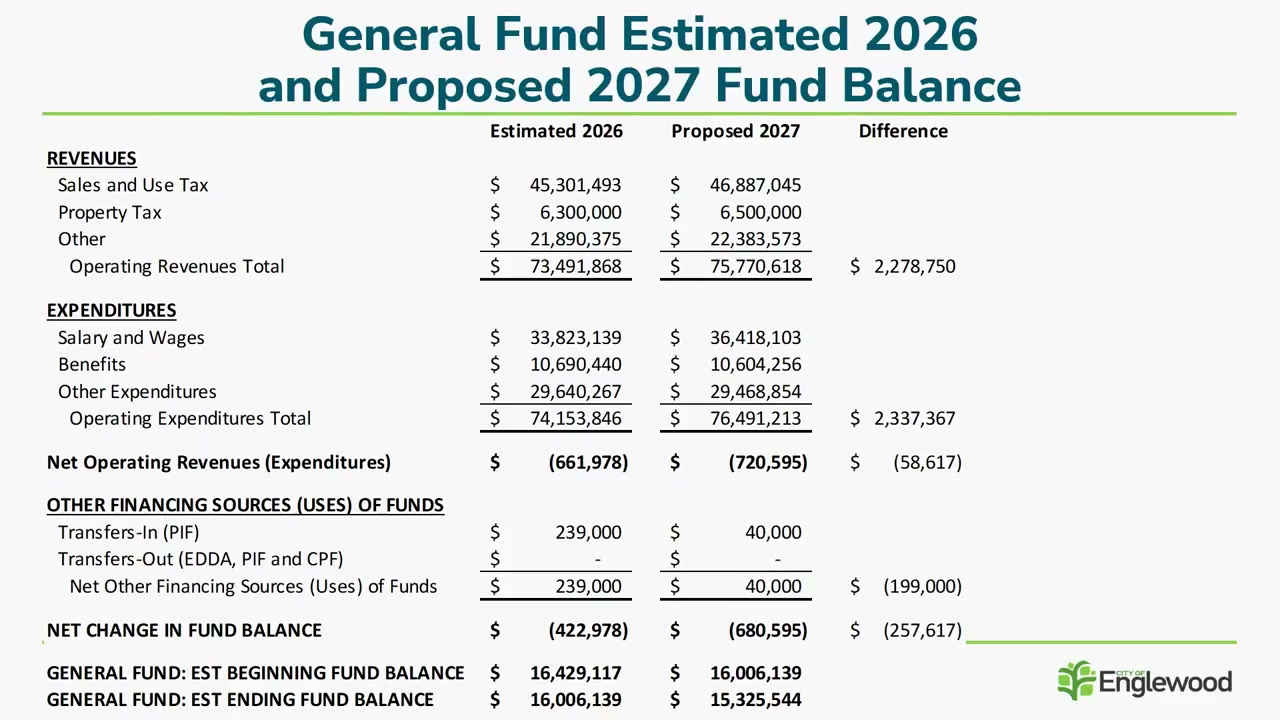
The proposed 2027 budget retains an approximately $680,000 general-fund operating deficit after transfers and would leave about $15.3 million in unrestricted reserves, or 16.9% of revenues, slightly above the city’s 16.7% target. A pending labor-arbitration matter could require roughly $250,000 more if the union prevails; the supplied record does not show the arbitration’s outcome or final cost, according to an Aug. 10 City Council study-session presentation.
The proposed water and sewer rates would each increase 4.5% in 2027, while connection fees for both services would rise 3.92%. The monthly water Capital Investment Fee for a single-family residential customer would increase from $17 to $19. The $5 Drinking Water Loan Fee would remain unchanged.
The proposed stormwater rate would increase 6% for one year, which staff described as about 35 cents more per month. Staff said the increase is needed to meet debt-coverage requirements and fully fund operations. The packet does not provide a typical residential bill or enough usage information to calculate a precise customer-level impact.
The proposed rates would take effect Jan. 1, 2027, if approved by City Council. A public hearing on the proposed budget is scheduled for Sept. 21, with ordinances anticipated in October. The Aug. 11 Water and Sewer Board packet contains the proposed rates, enterprise-fund budgets and watering-restriction resolution.