
Denver police outline coaching-based option for some misconduct cases as oversight dispute grows
A proposed Education-Based Development track would divert some low-level Denver police misconduct cases from standard discipline to training and coaching, while the Office of the Independent Monitor and council members question transparency, oversight access and who would control the pilot.
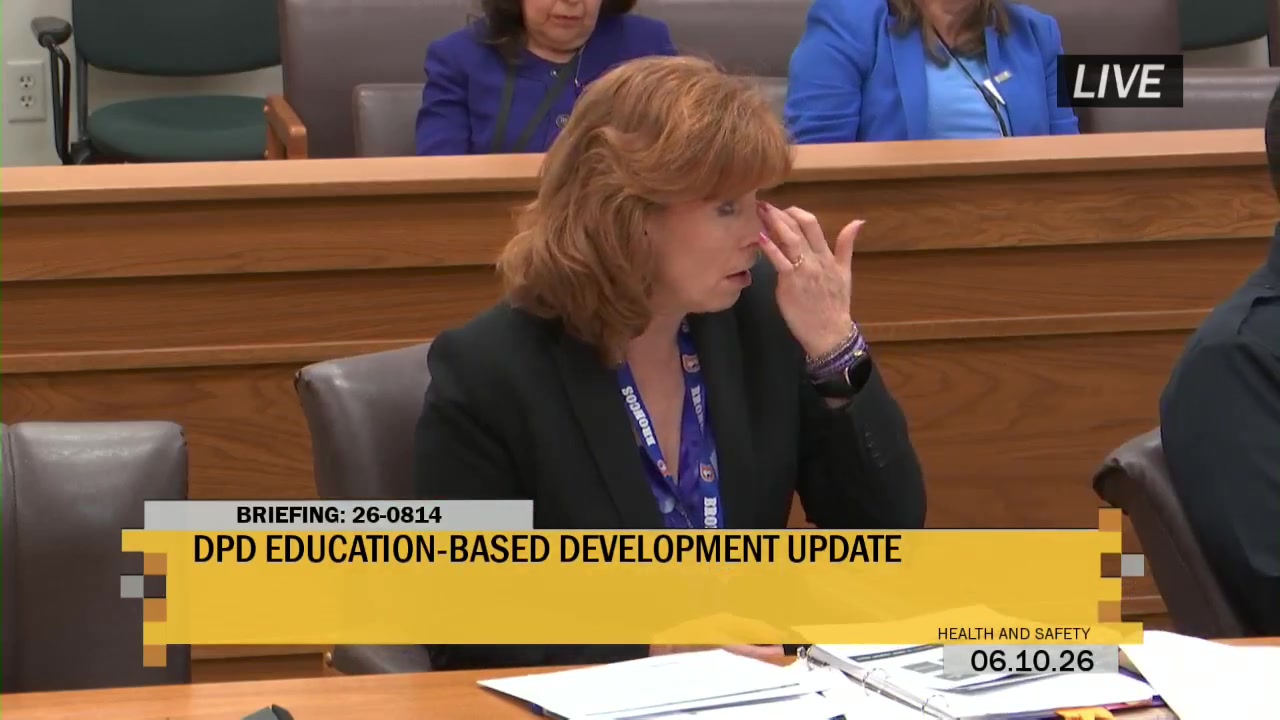
Denver police have publicly outlined a limited, voluntary alternative to traditional discipline for some lower-level misconduct cases, but a June 10 briefing to the City Council’s Health and Safety Committee showed the sharper dispute is over whether Denver’s civilian watchdog will have enough access and authority to independently verify how the program works.
Under the proposal, called Education-Based Development, or EBD, police and Department of Safety officials said the program would apply only to a narrow set of lower-level allegations and is intended to resolve those cases faster than the city’s regular disciplinary system. That timing matters because the Office of the Independent Monitor’s 2025 annual report said Denver police cases that went through disciplinary review had a median overall processing time of 282 days in 2025.
The draft Denver Police Department policy says a case must first be found eligible for EBD. An officer may then voluntarily accept the program or choose traditional discipline instead. If the officer accepts, the disciplinary case is deferred while the officer completes an individualized education plan. If the officer declines, or fails to complete the agreement, the case returns to the ordinary discipline process.
The proposal would not replace police discipline wholesale. The draft policy’s appendix limits eligibility to selected Conduct Category A and B violations and marks many others as ineligible. Examples of eligible allegations include rules on giving a name and badge number, responsibilities to serve the public, and some fellow-officer respect requirements. In the department’s council presentation, officials said eligible cases generally would be ones whose presumptive penalties now range from an oral or written reprimand to no more than one or two days of fined time.
Major categories would remain outside the program. The draft appendix excludes use-of-force allegations, deceptive acts, law violations, intoxication-related misconduct and many other C-through-F offenses. It also lists “Impartial Attitude – Bias” as ineligible.
Even for eligible cases, EBD would produce a different result from standard discipline. The draft policy says that if an officer completes EBD, “there will not be a sustained finding.” In its 2025 semiannual report, the monitor’s office said that consequence is significant because sustained findings can be used to increase penalties in future cases.
That report also said any EBD program should still require investigations certified by OIM, agreement between DPD and OIM on what review track a case takes, and sustained findings that remain available for future penalty escalation. OIM has said publicly that it opposes the proposal in its current form.
At the June 10 committee hearing, the dispute centered not just on policy design but also on access to records and on who gets the final say. Independent Monitor Liz Pérez Castle told council her office had received summaries and spreadsheets about public feedback on the proposal, but not the underlying questionnaires, limiting OIM’s ability to independently test the department’s claims about support. Council members also questioned whether the survey included open-ended responses, language-access planning, demographic safeguards or proof that respondents lived in Denver.
According to DPD’s presentation slides, the department collected more than 800 survey responses and found majority support on several questions. But minutes from the Citizen Oversight Board’s April 24 meeting say the monitor separately raised concerns that DPD had not shared the names of people who submitted public comments on the policy, despite OIM’s position that it is authorized to handle confidential information.
The oversight dispute matters because Denver’s operating documents for the Office of the Independent Monitor say the office is supposed to actively monitor investigations of uniformed personnel and make recommendations on discipline and policy. The draft EBD policy keeps OIM in the process, but not always with veto authority. If OIM wants changes to an individualized education plan and DPD does not accept them, the policy says the matter may be elevated to the executive director of public safety, who would make the final decision after consulting both sides.
Council members signaled skepticism about that arrangement at the June 10 briefing, warning that the city should not speed up accountability in lower-level cases by weakening independent oversight. The committee also raised whether vacancies on the Citizen Oversight Board should be filled before any broader rollout.
What happens next remains unsettled. Citizen Oversight Board minutes from January and March indicate that Department of Safety Executive Director Al Gardner had not approved a final policy as of January, was considering any approved version as a pilot, and that Chief Ron Thomas later described the program as a one-year pilot to be evaluated after launch. Officials referred to the policy as being piloted at the June 10 committee briefing, but the public record reviewed for this story still leaves open whether further handbook revisions, final approvals or disclosure decisions must happen before a full rollout.
For now, the clearest development is that Denver police have put forward a concrete, limited and voluntary alternative for selected low-level misconduct cases — and that its near-term future may depend as much on settling the oversight dispute as on the training model itself.