
Arapahoe County supports proposed scooter pilot expansion, but approvals remain
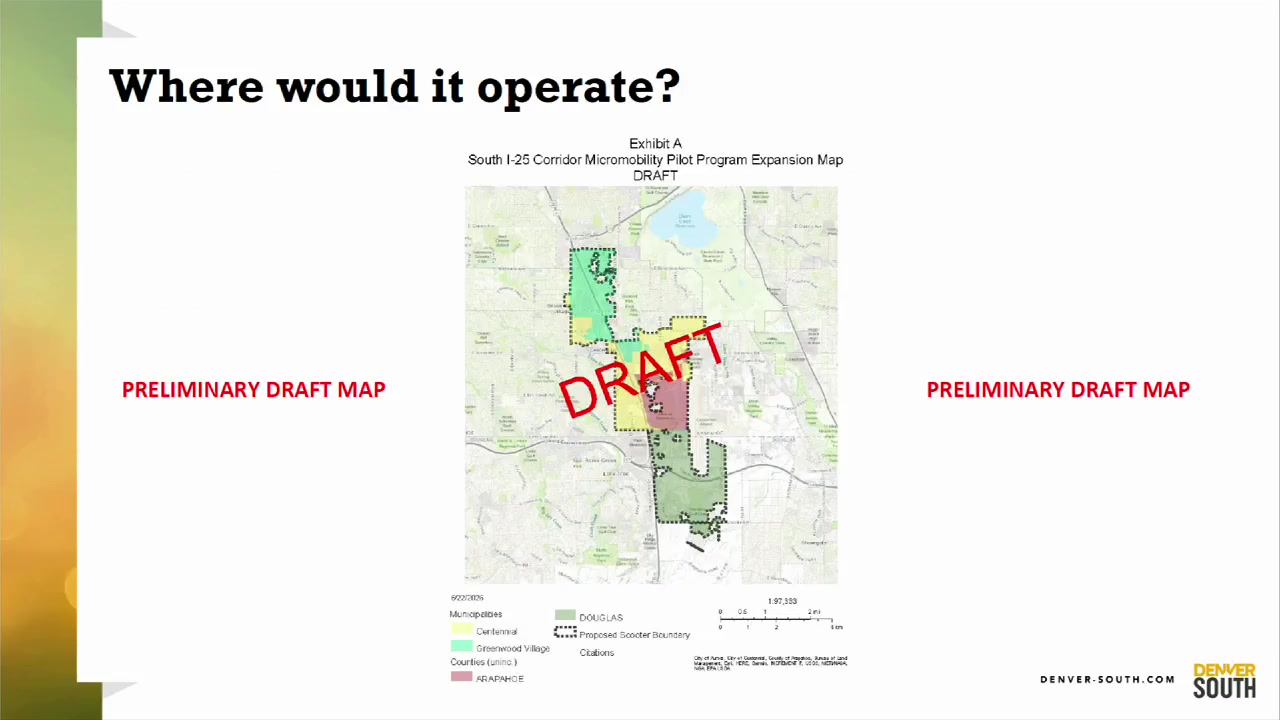
Commissioners gave policy-level support to a proposed 210-device pilot connecting parts of Arapahoe and Douglas counties, but no contract was approved and the map remains preliminary.
Published at
Arapahoe County commissioners supported expanding a southeast-corridor scooter pilot from about 160 devices to 210 during a July 13 study session, but they did not approve a contract or other final action.
The proposed one-year pilot would connect service areas in Centennial, Greenwood Village and unincorporated areas of Arapahoe and Douglas counties, including Meridian, Inverness and the Greenwood Entertainment District. The preliminary map does not establish final street-level boundaries or parking locations. The county’s Legistar record identifies the item as a study-session presentation with no final action history.
The target operating period is Sept. 1, 2026, through Aug. 31, 2027, contingent on approvals from participating jurisdictions and metropolitan districts. County staff said next steps include discussions with Centennial and Greenwood Village, approval by their elected bodies and a county license agreement covering scooter placement, sidewalk and ramp obstructions, device distribution and customer service. That agreement would return to the Board of County Commissioners because Public Works cannot sign it.
The board summary says the expansion would come at no cost to Arapahoe County or the cities. Riders would pay a $1 unlock fee, while Denver South and the Goldsmith, Greenwood Consolidated, Inverness and Meridian metropolitan districts would cover the remaining charges. Denver South would manage the program, and Spin is the proposed operator. The materials do not provide partner-by-partner amounts, a total cost or an executed funding agreement.
Spin’s proposed operations plan includes daily rebalancing, maintenance, designated parking, local ground operations and responses to reports of devices obstructing public rights of way. The plan caps the fleet at 210 devices unless participating partners give written consent and calls for operational data to be provided to the county and Denver South.
The pilot’s proposed evaluation would track ridership, safety, aesthetics and community support through quarterly aggregate reports to program participants. The reports would include trips, customer-service inquiries, estimated car trips and mileage displaced, safety incidents and injuries, trip coordinates, heat maps and trip length and duration. More than one reported safety incident in a calendar month would trigger a stakeholder meeting and possible changes to geofenced zones, the service area or user education.
The decision-support framework describes those measures as tools for deciding whether to make the program permanent after the one-year pilot. The materials do not promise that reports, heat maps or underlying data will be posted publicly or released as open data. A confirmed launch date, final service map, parking locations, partner approvals and a completed Spin contract change also remain unresolved.