
Denver council weighs tighter rules for transportation fund as parking, enforcement spending draws scrutiny
Sponsors want to tie the fund to adopted transportation plans, bar general-fund transfers and split spending evenly between capital and operations, but enforcement and legal questions remain.
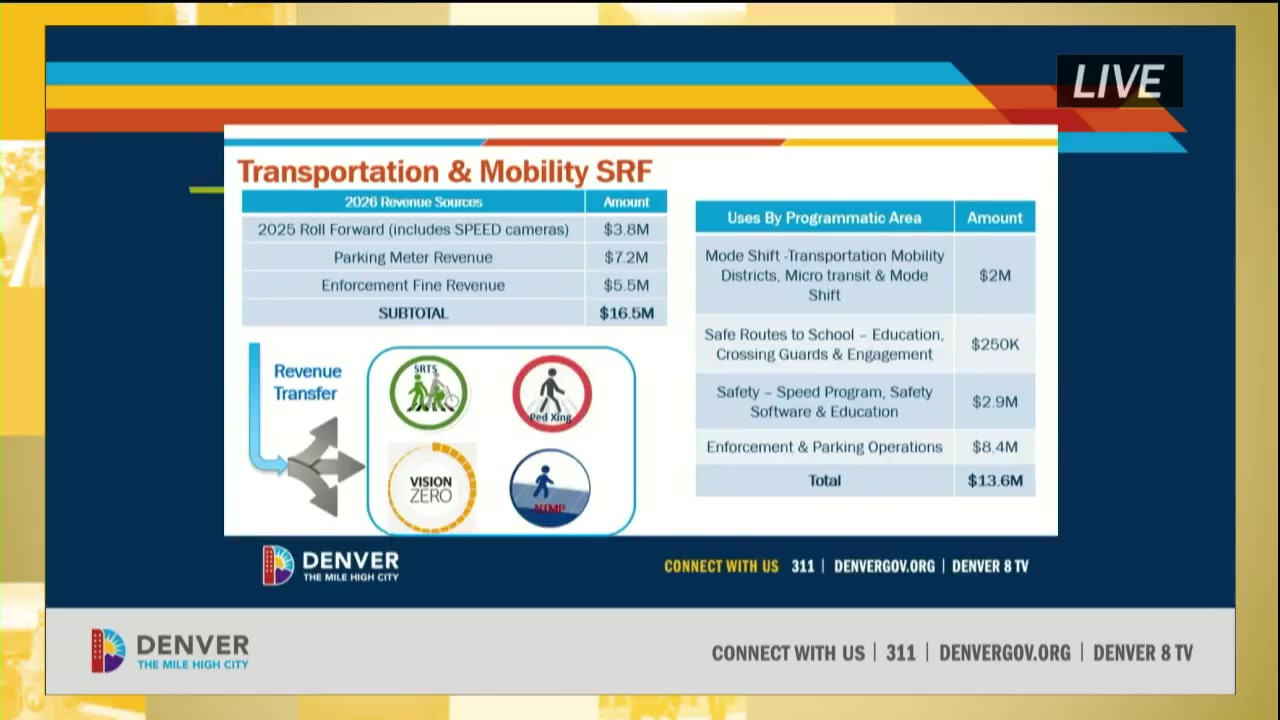
Denver City Council sponsors are considering new restrictions on a transportation fund that, according to figures presented by sponsors, collected about $16.5 million in 2026 and directed roughly $8.4 million to enforcement and parking operations. That left less than half for pedestrian, bicycle, transit and safety work, they said.
The Budget and Policy Committee discussed the proposal July 27 but took no formal action. The draft would limit the Transportation and Mobility Special Revenue Fund to projects tied to adopted plans, including the Vision Zero Action Plan, Safe Routes to School and Denver Moves plans. It also would bar transfers to the general fund, allow unused money to roll over and require an even split between capital and operating expenses.
The changes could affect current uses that do not fit those definitions. Andy Ford, the department’s executive director, said the fund helps pay for microtransit and transit mobility associations, parking-citation review staff, transit-signal staff and maintenance, speed cameras and parking software. He said speed cameras received about $2 million and parking-appeal staff cost roughly $300,000 to $400,000 — figures presented during the discussion.
Sponsors said eligible capital work could include protected bike lanes, bus or accessibility lanes, traffic calming, bike and scooter corrals, bus-stop infrastructure, transit-speed improvements and road diets. They described the draft as excluding general traffic-signal work, routine street maintenance unrelated to mobility improvements, traffic modeling, unrelated signage, police base enforcement and removal of pedestrian, bicycle or transit safety infrastructure.
The committee discussion did not settle how the city would determine plan eligibility or enforce the 50/50 split. Ford said the department was breaking out current spending by asset class and program. Sponsors also floated having the department’s advisory board review and approve proposed uses each year.
That idea raised a legal question. Councilmember Torres said the board’s charter role is to advise, review and comment, and questioned whether it could receive approval authority. Sponsors said the concept was exploratory. The advisory board bylaws describe a role focused on budget input and recommendations, not final budget approval.
The proposal also leaves unresolved how the city would handle plans that change or overlap, which official would enforce the rules and what would happen if a budget failed the capital-operations test. Sponsors said they had obtained draft language the week before the meeting and wanted feedback from the city’s Budget and Management Office and the department before moving forward.
Implementation in the 2027 budget cycle remains an open question. The city’s 2027 budget calendar calls for planning through Sept. 15, a first proposed budget in September and council adoption Nov. 9. The fund overhaul would require further drafting, legal review and approval; no changes were adopted July 27.