
Littleton proposal would raise typical stormwater charge $75 a year
A draft 10-year utility plan would increase stormwater revenue 60% in 2027 and 2028, restructure sewer billing and fund about $329 million in capital work. Rates and affordability assistance are not final.
Littleton is considering a 10-year sewer and stormwater rate plan that would increase stormwater revenue 60% in each of 2027 and 2028 and sewer revenue 15% in both years. The proposal is part of the city’s 2027 budget process and has not been adopted. City Council is scheduled to discuss it Aug. 11 at a study session, not a formal vote, according to the council packet.
For a typical single-family property, the proposed 2027 stormwater charge would rise from $124.54 to $199.26 annually — $74.72 more, or about $6.23 a month when annualized. Actual charges vary by property type, impervious area and development status.
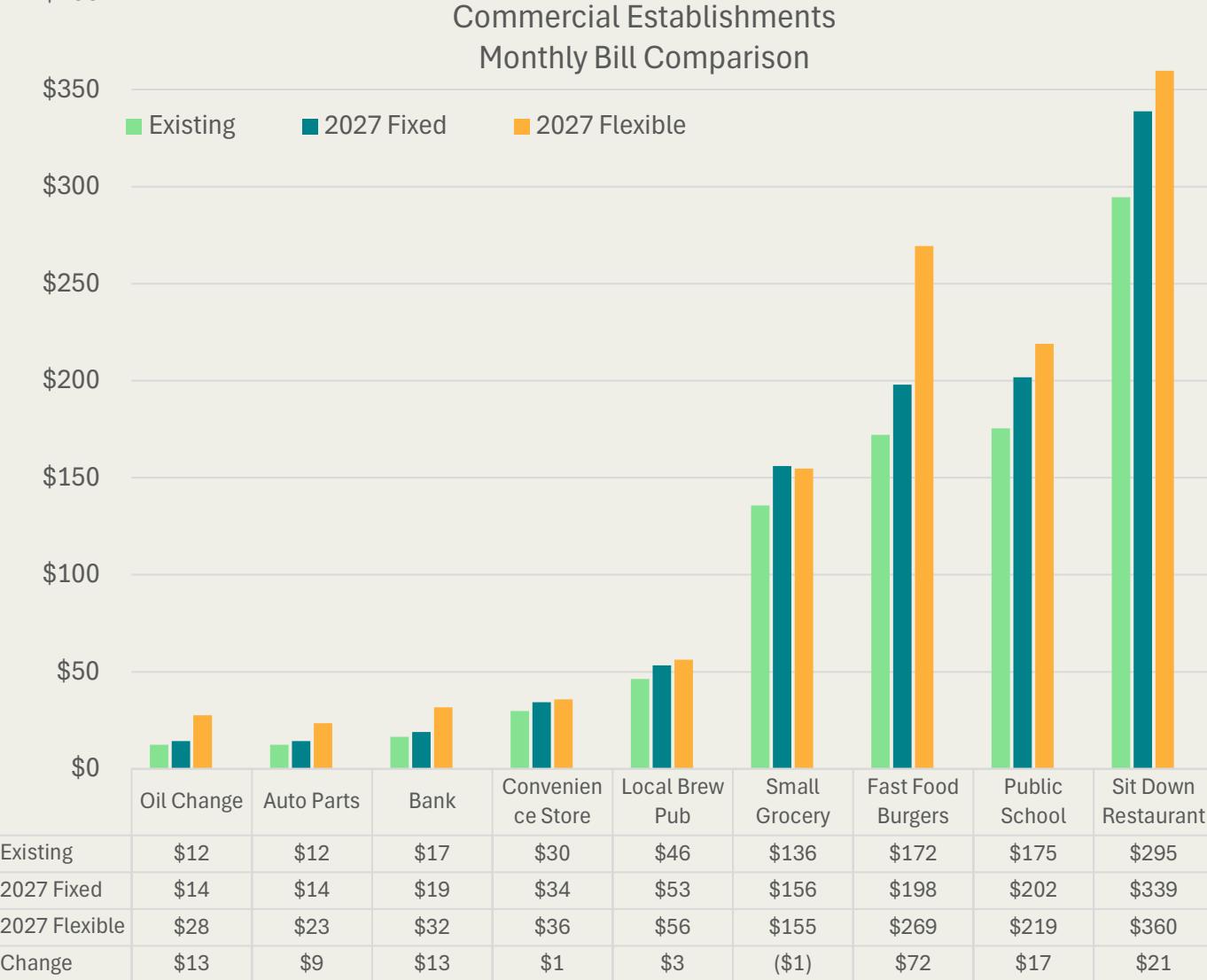
The proposal would replace the current residential fixed sewer rate with a fixed charge plus a volume charge based on average January-through-March water use. Commercial customers would be billed on actual water use, described in the presentation as 12-month consumption. Multifamily customers would be charged per dwelling unit.
Inside city limits, the proposed 2027 sewer rate is $15.25 per residential or commercial bill plus $4.10 per 1,000 gallons. The multifamily rate would be $11.44 per unit per bill plus the same volume charge. City examples put a single-family monthly bill at $23 for 2,000 gallons of average winter use and $40 for 6,000 gallons. At 3,000 to 4,000 gallons, example bills are $28 to $32, compared with about $30 under the 2026 fixed rate.
Staff estimates the average single-family sewer increase at about $1.66 per month under the flexible structure, compared with about $3 if the city keeps a fully fixed rate. Commercial impacts vary by water use, with an estimated average increase of roughly $4 to $8 per month. The examples do not show how many customers would pay more or less.
The plan identifies about $256 million in sanitary-sewer capital needs over 10 years, including roughly $180 million for the jointly owned South Platte Renew treatment facility. It also calls for repairing or replacing 24 miles of sanitary sewer and modernizing the treatment facility to meet federal environmental requirements. Stormwater work is estimated at about $72.4 million to $73 million and includes replacing 15 miles of storm drains. Rangeview Gulch, listed at $8 million, is identified as a major driver of the initial stormwater increase.
The financing assumptions include a $65 million cap on sewer debt issuance. The plan prioritizes WIFIA financing, followed by state loans and revenue bonds, with the remainder funded through rates, reserves, tap fees and other operating revenue. For stormwater, the presentation lists $10.8 million in revenue bonds, $12 million in state loans and $49.6 million from other revenue, including rates and tap fees.
The packet does not provide a complete project list or category-level dollar breakdown. It also contains a discrepancy: a staff communication says stormwater revenue would rise 5% annually from 2029 through 2035, while a presentation says 5.2%.
Billing frequency is unresolved. Littleton currently bills sewer and storm drainage annually, while staff is seeking input on monthly, bimonthly, quarterly, semiannual or annual billing. No change has been approved.
The city has not established an income-qualified discount program. Staff proposed studying reduced sewer and stormwater rates for lower-income customers, but eligibility, administration, funding and treatment of multifamily or master-metered properties remain undecided. The packet says the program could require higher rates for customers who do not qualify or a city subsidy.
Two public outreach events are scheduled. The city’s rate-study project page lists an in-person open house from 4 to 6 p.m. Aug. 26 at Littleton Center, 2255 W. Berry Ave., and a virtual webinar from 5:30 to 7 p.m. Sept. 3. The city says feedback will be shared with the council before the 2027 budget is finalized.
The rate-study timeline lists a Sept. 12 budget workshop and Nov. 3 budget adoption, with new utility rates expected to take effect in January 2027. The dates and proposed rates remain subject to change.