
Denver projects $196.4 million General Fund balance as 2027 budget nears
Denver’s Finance Department reports General Fund collections through June were 2.3% above the same period in 2025, while the projected year-end balance remains below the city’s 15% reserve target.
Published at
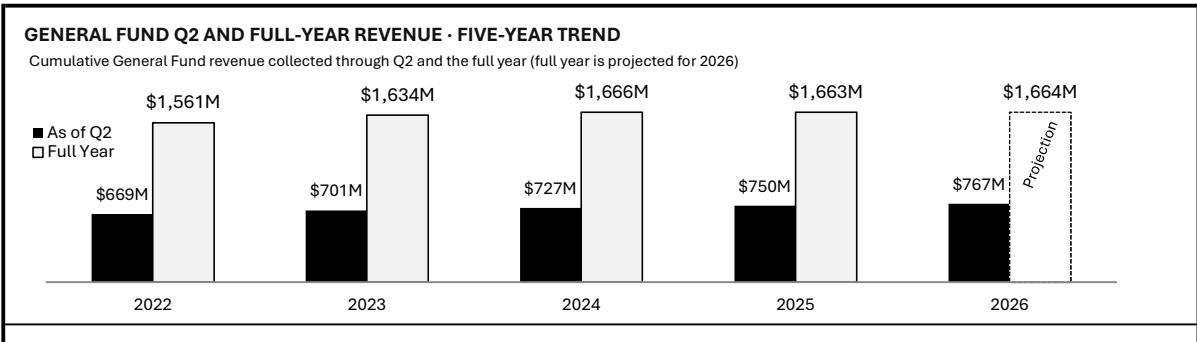
Denver collected $766.6 million in General Fund revenue through June, 2.3% more than during the same period last year, and is projecting a $196.4 million year-end balance as the city prepares its 2027 budget.
The Denver Department of Finance’s second-quarter report to City Council says the collections represent 46.1% of the city’s unchanged $1.6648 billion full-year revenue forecast. The department projects another $897.8 million in revenue for the rest of 2026.
The projected balance would equal 11.8% of estimated expenditures. That is below Denver’s 15% policy target for unassigned General Fund reserves but above the 10% level the city generally should not fall below except during a severe economic or other crisis, according to the city’s 2026 budget and reserve policies.
The quarterly report does not identify the $196.4 million projection as a formal reserve target, explain which fund-balance categories it includes or provide the expenditure calculation behind the 11.8% figure. All figures in the report are unaudited.
Sales and tourism-related revenue lead gains
Sales and use tax produced the largest increase among major revenue sources, rising 9.8% from the same period in 2025 to $373.4 million. Lodgers’ tax increased 33.5% to $15.3 million, while the Xcel Energy franchise fee rose 22.4% to $15.8 million.
Property tax collections reached $183.1 million, or 93.9% of the city’s $195 million annual forecast, and increased 1.3% year over year. Investment income rose 4% to $10 million.
Some sources declined. Occupational privilege tax fell 6.4% to $21.3 million, motor vehicle tax declined 7.3% to $14.5 million, and street-occupancy permit revenue dropped 6.4% to $8.1 million. Parking fines fell 2.4% to $11.9 million, while highway users tax declined 0.9% to $8.4 million.
The Finance Department cautioned that the comparison with 2025 is affected by a $25 million one-time transfer early last year and that collection timing varies among revenue sources.
Possible effect on the 2027 budget
The city is not yet revising its 2026 forecast. Finance officials said it is likely to be revised slightly upward when the proposed 2027 budget is released Sept. 15 if current trends continue.
Additional revenue would give budget writers more to consider but would not commit the city to new services or spending. Denver’s budget policy says fund balance above the 15% target may be used for one-time or capital expenses and debt reduction, rather than ordinarily paying for ongoing costs. Fund balance between 10% and 15% may be used for one-time spending or short-term stabilization while the city considers longer-term structural balance.
Denver’s 2027 budget process began May 1. The mayor’s proposed budget is scheduled for release Sept. 15, followed by City Council review and amendments before planned adoption Nov. 9, according to the city’s 2027 budget-planning announcement.
If the city receives unanticipated current-year revenue, Ballot Measure 2G allows City Council to initiate appropriations, subject to mayoral review and a possible veto. The report identifies no specific 2027 service expansion, appropriation or spending proposal tied to the projected balance.
The city’s 2025 annual financial report listed $113.14 million in unassigned General Fund balance at year-end, equal to 6.16% of General Fund expenditures, and $296.32 million in total General Fund balance. Those figures are not directly comparable to the quarterly report’s $196.4 million projection because the report does not define which categories are included.