
Denver, RTD to present Welton transit options Aug. 27 amid rail funding warning
A joint study will show draft alternatives for Welton and Downing streets as RTD warns that federal and matching funds for rebuilding Welton rail infrastructure could require repayment if the work is not completed.
Published at
Denver and RTD will present draft transit alternatives and fatal-flaw screening results Aug. 27 for a study examining the future of Welton and Downing streets. RTD also warns that federal and matching funds tied to rebuilding aging Welton rail infrastructure could be jeopardized if the work is not completed, potentially requiring repayment of millions of dollars.
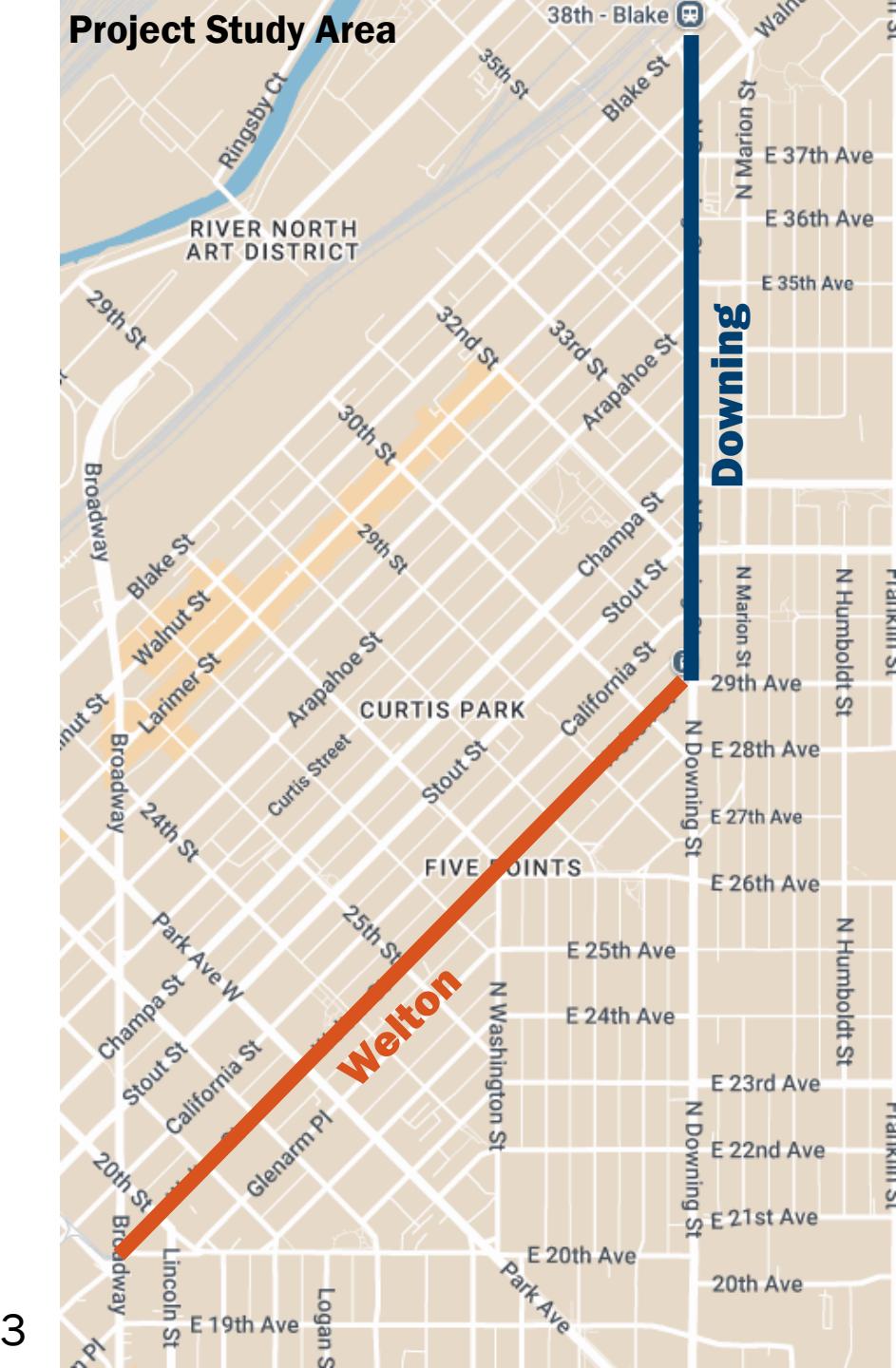
The virtual public meeting is scheduled for 5:30 to 7 p.m. Thursday, Aug. 27. The city’s Welton Next Steps project page says the study covers Welton Street from Broadway to Downing Street and Downing Street from Welton to Blake. Residents will be asked to comment on draft alternatives and initial screening results.
The joint Denver Department of Transportation and Infrastructure-RTD study follows questions about the planned Central Rail Extension on Downing. RTD’s project history identifies the L Line Extension as part of the 2004 voter-approved FasTracks plan. The extension would connect the existing 30th & Downing Station with the A Line at 38th & Blake, with proposed stations at 33rd & Downing and 35th & Downing.
RTD completed environmental evaluation, route and operating-plan analysis, a mobility study and basic engineering between 2010 and 2015, but the extension has not been built. RTD’s 2025 Finishing FasTracks report says a 2014 study found that trains sharing the street with vehicle traffic would not be reliable enough to support a workable service schedule. The report also says the project did not meet financial-justification criteria under the assumptions used and needs additional study to establish a final alignment and operating plan.
Materials prepared for an Aug. 19 Denver Transportation and Infrastructure Committee briefing say the Welton Next Steps study builds on earlier planning for a possible two-way conversion of Welton and later work that questioned the feasibility of the Downing rail extension. The presentation does not detail those technical or financial concerns.
The study has not released named final route choices. The team is combining transit modes, operating guideways and street configurations, then testing complete corridor alignments against community goals. The available record does not identify the specific vehicle types, alignments or guideway combinations expected to be shown Aug. 27.
RTD Director Michael Guzman told the committee that the agency has a federal grant and local matching funds for full-depth reconstruction of the Welton corridor’s oldest light-rail track infrastructure. The work would replace underlying infrastructure, including drains, ballast and poured concrete, rather than provide routine maintenance. Guzman said RTD received the grant in 2023, though he qualified that date, and that the RTD board allocated funds in its 2024 budget for a rolling construction and design-build plan. Guzman’s committee remarks did not identify the grant amount, local match or repayment amount.
Guzman said the funding carries “a bit of a time limit” tied to RTD fiscal policy and the requirement to match federal funds. He said RTD probably should have decided about the work sooner than September, but did not give a firm grant-expiration or construction-completion deadline. If RTD does not perform the planned work, he said, the agency could have to return millions of dollars to the federal government, along with any remaining RTD-specific funds, unless it modifies the arrangement with its Federal Transit Administration partners.
The project team expects to advance one or two alternatives for more detailed technical work, including traffic modeling, in winter or spring 2027. A preferred alternative is expected to be selected in 2027, followed by conceptual design and an implementation strategy by summer 2027. Potential final design is listed for 2028-30 or later and construction for 2030-35 or later, depending on funding and project complexity. Those are planning estimates, not a commitment to begin construction in 2030.
The reconstruction funding warning concerns existing Welton rail infrastructure and is separate from the lack of an identified construction funding package for any future corridor alternative. The planning study itself is supported by a $964,000 Federal Transit Administration grant, including local matching funds. The committee record does not establish whether that planning grant is the same federal funding Guzman discussed for rail reconstruction.
The Aug. 27 engagement phase is expected to include a public survey and outreach using English- and Spanish-language materials. The meeting will be the next opportunity for residents and corridor users to comment before the team narrows the alternatives.