
Denver council weighs up to $941,000 in fees on voter-approved sales-tax funds
Council members discussed proposed administrative fees, spending restrictions and new provisions for Prosperity Denver and Caring for Denver, but took no final action Aug. 24.
Published at
Denver City Council members discussed proposed administrative fees and spending rules for three voter-approved sales-tax funds Aug. 24, but took no final action. The Budget and Policy Committee discussion left the proposed fees, administrative-cost limits and ordinance timeline unresolved.
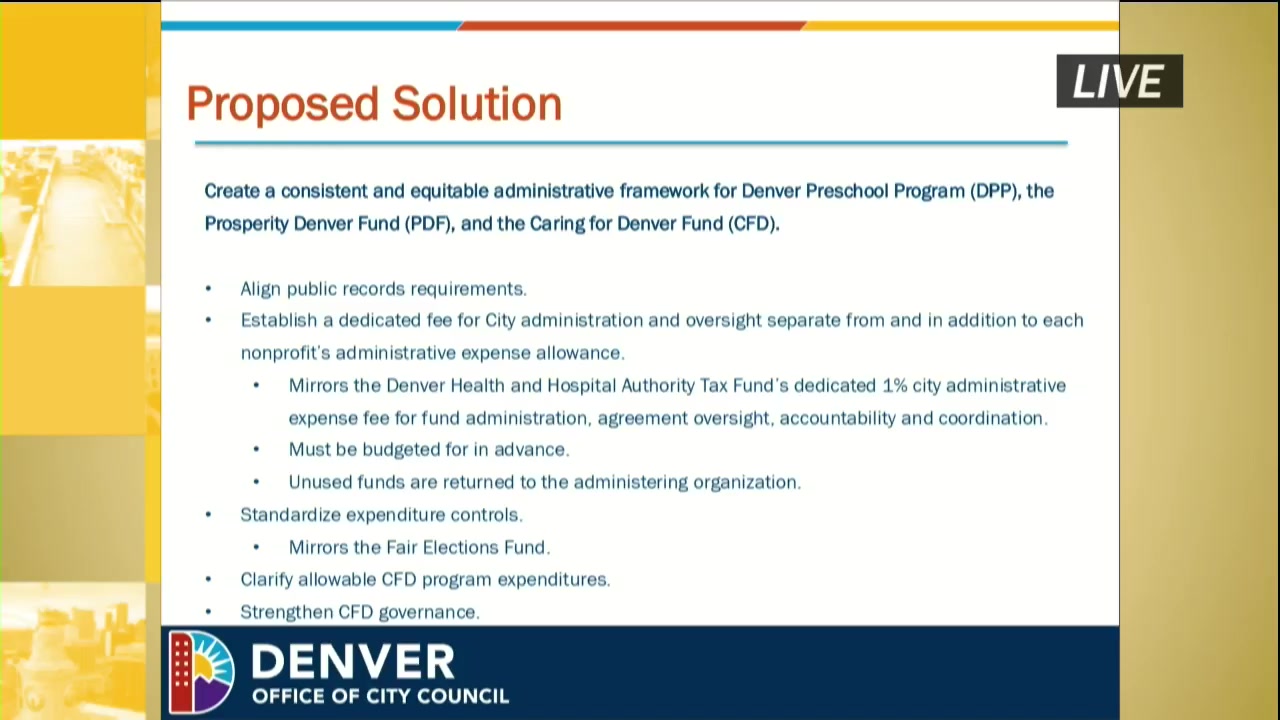
The proposal would allow the city to charge up to 1% of revenue collected for the Denver Preschool Program, Prosperity Denver and Caring for Denver, in addition to the nonprofits’ existing administrative allowances. The proposed amendments project 2027 fees of $280,000 from the preschool fund, $145,000 from Prosperity Denver and $516,000 from Caring for Denver — about $941,000 total.
The city says the fees would cover personnel and services for administration, accounting, legal work, budget management, monitoring, compliance and reporting. The amounts would be budgeted in advance, with unused money returned to the administering nonprofits. Because the fees would come from dedicated sales-tax revenue, they could reduce funds available for preschool assistance, scholarships, grants or behavioral-health services. The proposal does not quantify that effect and would not eliminate the nonprofits’ existing administrative allowances.
The amendments would generally bar administrative funds from paying for food, beverages, alcohol, marijuana or tobacco. Council discussion clarified that the food restriction would not prohibit all food purchases: funds could cover food, beverages and related services for qualifying events that benefit the applicable program. Routine employee meals would not qualify, but the proposal does not fully define qualifying events.
Prosperity Denver’s existing structure includes a 5% administrative allowance and a separate 5% allowance for database maintenance and capacity-building, according to the committee discussion. Council members questioned whether those allowances should remain separate, be consolidated or be treated as a 10% combined allowance. That issue remained unresolved Aug. 24.
For Caring for Denver, the proposal says the foundation would retain about $130,000 more annually because it would no longer reimburse the city for one full-time-equivalent position. The foundation would retain its existing allowance of up to 5%, while the city’s separate 1% fee would support oversight. The amendments also would require a more detailed strategic plan and expressly authorize support for alternative-response programs such as STAR, including models that do not involve law enforcement. The required level of detail for the plan remained under discussion.
The changes follow a February audit by the Denver Auditor that found problems with Caring for Denver’s administrative spending, grant management and conflict-of-interest disclosures. In the Feb. 19 audit report, auditors found that 571 of 734 sampled administrative expenses lacked supporting documentation and were considered questionable; 83 were not allowable under city fiscal rules. Most involved meal reimbursements, including meals and alcohol. The audit also found missing or improperly reviewed grant documentation and late conflict-of-interest and outside-employment forms.
Sponsors said they were working on language addressing questions about administrative-cost percentages and whether city agencies could reduce budgets in anticipation of receiving the new fees. The available record does not establish the final administrative costs, the effect on grants or services, the precise scope of qualifying food-related events or whether all audit recommendations have been completed.
The next listed steps are Governance and Intergovernmental Relations Committee consideration Sept. 15, first reading by the full council Sept. 28 and final reading Oct. 5. The Oct. 5 schedule also calls for three public hearings and eight supermajority votes. Those actions are scheduled, not completed; the Aug. 24 discussion did not establish committee approval, first-reading action, public-hearing testimony, final passage or enactment.