
Denver airport roof contract cites aging tent roofs but sets no repair sequence
A proposed Birdair agreement would cover inspections and repairs at DEN, but available records do not establish a current failure, repair schedule, execution date or passenger-disruption plan.
Published at
A proposed Denver International Airport agreement with Birdair Inc. would provide up to $2.5 million for inspections, testing, maintenance and repairs of the airport’s aging PTFE-coated tensile-fabric “tent” roofs. The contract does not identify a current failure, set a repair schedule or rank which components would be fixed first.
The Birdair contract says the roofs, installed during the airport’s original construction more than 30 years ago, have reached the end of their estimated useful life and “must be replaced.” It attributes degradation primarily to ultraviolet exposure and weather. The document says the inner layer appears to be in better condition because it is protected by the outer layer, but it includes no quantified engineering results, photographs or component-specific failure findings.
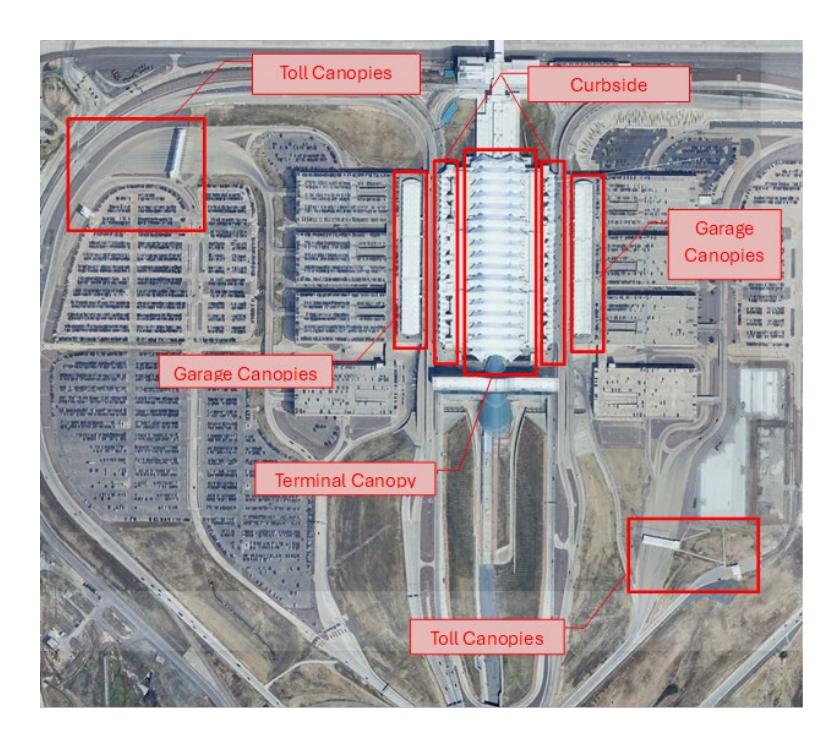
The work would cover the Jeppesen Terminal’s fifth and sixth levels, the east and west parking garages, and the east and west parking toll plazas. Potential work includes fabric membranes, cables, struts, masts, tie-downs, drainage systems, perimeter framing, inner liners, architectural infill and lightning protection.
Inspections and task orders, rather than a fixed component-by-component plan, would determine the initial work. Birdair must document deficiencies with written records, photographs and maps and bring conditions requiring “immediate and/or priority repairs” to airport maintenance staff. The contract calls for immediate, priority, safety and routine repairs during inspections when time, tools and materials are available. If a repair cannot be completed during an inspection, Birdair must arrange follow-up work based on urgency.
Testing may require removing and replacing fabric panels, cables, clamp bars, bolts and gaskets, with temporary supports installed as needed. Final reports must summarize safety and priority repairs, inspection findings, test results, recommendations, photographs and maps.
The records do not identify a current dangerous condition, a roof requiring closure or expected passenger disruption. The contract requires safeguards, warning signs and barricades where needed, and says equipment placement should minimize interference with public movement and normal airport operations. Birdair’s proposal says heavy traffic has historically limited material hoisting from Level 6 and that deliveries have been scheduled overnight during off-peak periods, but that is a contractor logistics statement, not a schedule for this work. Any repair would require a separate task order and written notice to proceed.
The contract contains unresolved financial and legal inconsistencies. Its populated amount is written as $2.5 million, while a numeric field says “$2,500,00.00.” It says payments would come from the Airport System Fund and be made only as appropriated and encumbered. A template provision describes a three-year base term with two one-year options, while the agreement’s main term provision says five years from the effective date, with up to two additional one-year extensions. Another provision refers to a “five percent (12%)” subcontractor markup.
The filed City Council resolution records Transportation and Infrastructure Committee approval by consent on Aug. 19 and a Mayor-Council date of Aug. 25. As of Aug. 27, the resolution’s council passage date and signature fields remained blank in the available record. The contract’s city-signature and effective-date fields were also incomplete, so the records do not establish that the agreement has been fully executed or is operative.
A fully executed agreement, official effective date, issued task orders and inspection reports would clarify whether the replacement finding has led to specific repair work, which components pose the greatest risk and whether airport users should expect closures or other disruptions.