
Denver proposal would limit city collection and sharing of gender data
Denver’s proposed ordinance would limit city collection, retention and sharing of sex- and gender-related information, with a committee hearing and public comment scheduled for Sept. 16.
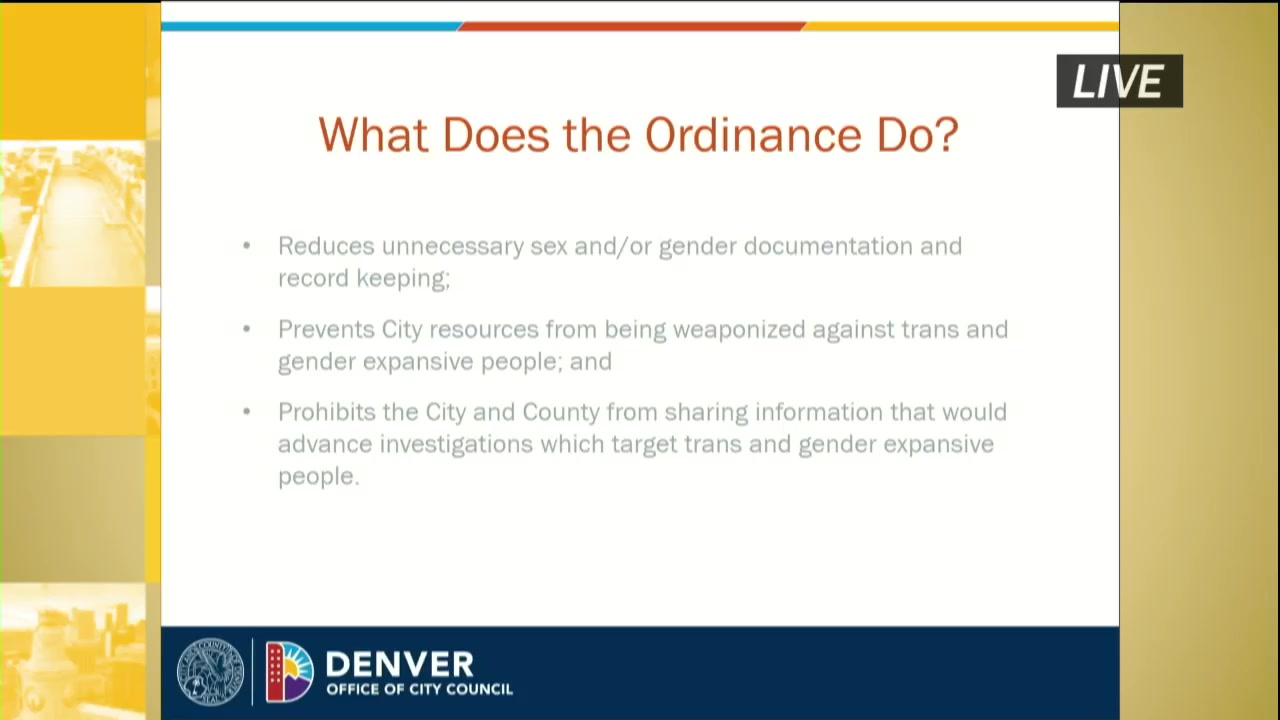
Denver officials are considering a proposal that would restrict when city agencies can collect, retain or share information about a person’s sex, sexual orientation, gender identity or gender expression, while allowing exceptions for services, legal requirements and other important city interests.
The proposed Sex and Gender Identity Protection Ordinance, sponsored by Councilmembers Stacie Gilmore and Shontel Lewis, would apply to city departments, agencies, boards, commissions, employees and contractors. The proposed ordinance has not been enacted; its fields for council passage, mayoral approval and publication remain blank.
The proposal would generally prohibit the city from requiring collection or disclosure of covered information unless federal, state or city law requires it or the information is needed to advance an “important city interest.” The ordinance lists human services, health and behavioral health care, criminal justice, shelter management and grant administration as examples.
When collection is required, the proposal would generally limit retention to 30 days. After that, the information would have to be permanently destroyed from city records unless it was needed for legal or regulatory compliance, covered by a state or federal records-retention schedule, or necessary to advance an important city interest.
The measure also would restrict Denver’s use of city funds, resources and law-enforcement personnel to help other governments collect or disclose the information, discriminate based on it, or investigate people based solely on those characteristics. It would limit certain contracts and data-sharing arrangements with outside law-enforcement agencies, including those involving program applications, intake information, census databases and technology-use agreements.
Internal sharing between Denver agencies would remain allowed. Agency heads could adopt implementation policies, and affected agencies would have to report to City Council within 90 days after the proposed Jan. 1, 2027, effective date on the covered information they collect and maintain. Annual compliance reports would follow beginning in 2027.
The proposal received an informational briefing Sept. 14 before the City Council’s Budget and Policy Committee. No vote or other formal action was taken. Council members asked about possible effects on the Department of Motor Vehicles, Denver Health contracts, boards and commissions, applications and internal census-style databases.
Gilmore said outreach to the Department of Motor Vehicles was pending and that the effect on Denver Health contracts would depend on existing contract language. She said the sponsors had not completed an inventory of the city’s applications and databases. Council members also asked who would monitor compliance and how agencies would automate the destruction requirement. Gilmore said agency directors would be responsible, with assistance from Technology Services, but that the detailed process still needed to be developed, according to the .